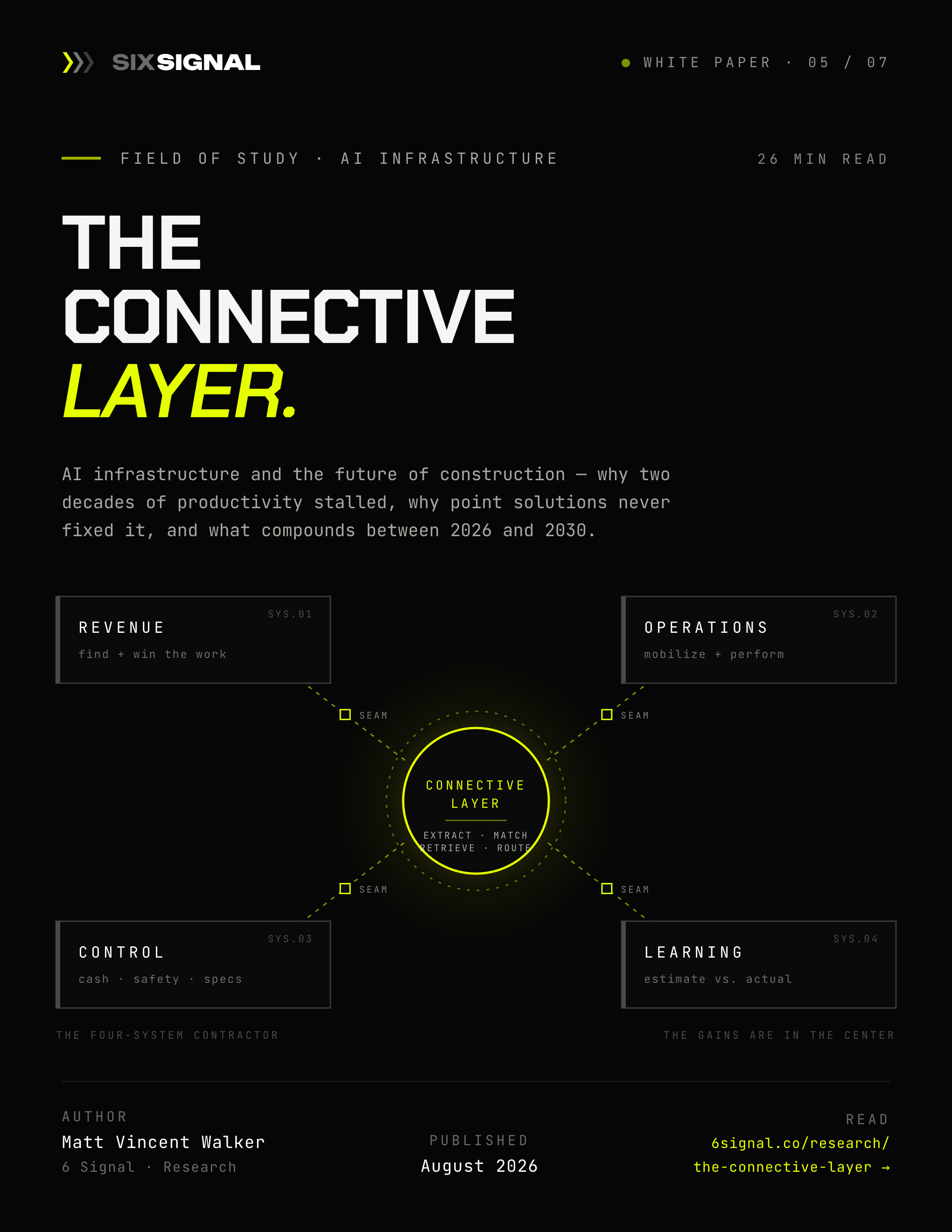
The Connective Layer: AI Infrastructure and the Future of Construction
Why the industry that builds everything digitized nothing — and what changes now that intelligence is cheap.
Author: Matt Vincent Walker Published: August 1, 2026 Read time: 26 min
Executive summary
This paper makes five claims, each argued from cited industry data:
- Construction's productivity stall is an information problem wearing a technology costume. Two decades of ~1 percent annual productivity growth coincide with the industry capturing enormous amounts of operational data and using almost none of it.
- Point-solution software failed structurally, not accidentally. Tools accelerated tasks inside departments while the seams between departments — where the losses actually occur — stayed manual.
- The unit of analysis is the company, not the tool. Every contractor runs four systems: revenue, operations, control, and learning. AI's economic role is the connective infrastructure between them.
- The capital has already moved. AI's share of construction-technology investment roughly doubled and then doubled again between 2023 and 2025, platform vendors are shipping agents, and autonomy is arriving as retrofit kits on existing iron — while most contractors remain in pilot purgatory. The gap between believers and users is the largest arbitrage in the industry.
- The winners of 2026–2030 will be boring. Not the earliest adopters of the flashiest tools, but the companies whose information survives its own handoffs — with human authority intact and a source behind every answer.
Part I — The longest stall in modern industry
Begin with the number that should embarrass a $13 trillion global industry: about 1 percent. That is construction's average annual labor-productivity growth over two decades, per McKinsey Global Institute's landmark analysis — against 2.8 percent for the world economy and 3.6 percent for manufacturing. The same research ranked U.S. construction second-to-last among all industries in digitization (ahead of only agriculture) and found the industry investing 1.5 percent of value-added in technology against a 3.6 percent economy-wide average. McKinsey priced the catch-up opportunity at $1.6 trillion a year, globally.
Two decades, one industry left behind. Sources: McKinsey Global Institute, "Reinventing Construction" (2017).
The conventional reading of this chart is "construction is slow to adopt technology." That reading has produced twenty years of failed initiatives, because it misdiagnoses the disease. Construction companies did buy technology — accounting systems, estimating software, project management platforms, GPS on the trucks. Productivity barely moved anyway.
The better reading requires a second set of numbers. FMI's research found that 95.5 percent of all data captured in engineering and construction goes unused. The follow-up study with Autodesk estimated that "bad data" — inaccurate, incomplete, inaccessible, or untimely information — may have cost the global industry $1.85 trillion in a single year, including roughly $88 billion of rework directly attributable to decisions made on bad information. PlanGrid and FMI's field research put a stopwatch on the human cost: construction professionals spend about 14 hours per person per week on conflict resolution, rework, and hunting for project information — $177.5 billion a year in U.S. labor cost alone.
Hold both sets of numbers together and the real diagnosis appears. Construction is not data-poor — a single active job produces receipts, tickets, timecards, photos, texts, RFIs, and change directives daily. Construction is connection-poor: nearly everything is captured somewhere, and almost nothing survives the trip between where it is captured and where it would change a decision. The productivity stall is what an industry looks like when its information dies in transit for twenty consecutive years.
Part II — Why the tools didn't fix it
The software industry's answer to construction has been the point solution: a better estimating tool, a better scheduling app, a better accounting package. Each genuinely improves the task it touches. None of them moved the industry's number, and the reason is visible the moment you trace one piece of information through a typical company.
The leaks are between the systems, not inside them. Each ✕ is a handoff that point-solution software leaves manual.
A receipt is photographed at a supply house at 7 a.m. — captured, technically. It surfaces at month-end, gets keyed against whichever job the bookkeeper guesses, and becomes a ledger line nobody reads by job. The estimating tool never learns what the job actually cost. The scheduling app never knew the change order existed. The accounting package accurately records a version of events that is ninety days old.
Notice what every point solution has in common: each one optimizes a node, and the losses live on the edges. The estimator gets faster inside the estimating tool; the handoff from estimate to field crew is still a PDF and a phone call. This is why a company can buy six systems and remain, informationally, a relay race run in the dark.
There was a rational reason the edges stayed manual: moving information between systems was clerical labor, and the clerical hours were unaffordable. A $3M contractor cannot staff a data analyst, a billing specialist, and a compliance coordinator. For thirty years, the correct business decision was to let the data die.
That constraint — not any tool — is what large language models actually removed. Reading a receipt, matching an invoice to a purchase order and a cost code, transcribing a foreman's voice note into a structured daily log, flagging the hours accumulating against work no estimate contains: this is precisely the work modern AI does cheaply, continuously, and without being asked twice. The technology's economic significance for construction is not that it is intelligent. It is that the connective tissue of a construction company just became affordable for the first time.
Part III — The four-system model
If the tool is the wrong unit of analysis, what is the right one? Strip any contracting company — a two-truck service outfit or a $50M civil GC — to what the business actually does, and you find the same four systems:
Four systems every contractor already runs. The compounding gains are in the center.
Revenue finds and wins work. Operations mobilizes and performs it. Control protects the company while the first two run — cash, safety, compliance, contracts, specifications. Learning turns outcomes into better future decisions, and in most companies is one owner's memory.
Inside each box, contractors are generally competent. The failures cluster at the seams — the proposal the field never fully reads, the extra work agreed in a 6:40 a.m. text and never billed, the closeout lesson that never reaches the next estimate. Which is exactly what Part I's data predicted: an industry that captures everything and connects nothing.
The four-system model reframes the AI question from "which tool should I buy?" to "which seam leaks most?" — a question with a measurable answer and a buildable fix. This model is developed at length, system by system, in The Intelligent Contractor series; this paper carries the argument to the infrastructure itself.
Part IV — The infrastructure stack
Call something "infrastructure" and you owe a bill of materials. An AI infrastructure for a contracting company has six working layers and one enclosing one:
Six working layers, one enclosing frame. Governance is not a layer you add later — it is the boundary condition of the whole stack.
Three properties distinguish this stack from a software shopping list:
It connects what exists rather than replacing it. The integration layer treats the accounting package, the CRM, and the platform subscriptions as endpoints, not victims. Rip-and-replace is how construction technology initiatives die; infrastructure that reads from and writes to what crews already use is how they survive contact with a Tuesday.
The knowledge layer is controlled, or it is worthless. An assistant answering safety or specification questions from the open internet is a liability engine — it will blend your superseded procedure, another jurisdiction's code, and a forum guess into one confident paragraph. Controlled means: approved sources only, versioned, jurisdiction-tagged, and every answer carries its provenance — document, revision, section, conflicts, and whether human review is required. The doctrine is argued fully in An Answer Without a Source Is a Liability; it is the single design rule that separates contractors AI will help from contractors AI will hurt.
The action layer terminates at humans. The stack prepares, reconciles, retrieves, flags, drafts, and explains. It does not approve payments, alter books, certify compliance, or make safety judgments — not as a temporary limitation but as a permanent design principle. AI may retrieve the trenching standard; it cannot see the ground move, smell the gas, or assume the legal role OSHA assigns to a competent person standing on the site. The full boundary list is in What AI Should Never Decide on a Construction Site. AI prepares; humans decide. Every credible deployment in this industry will be built on that sentence, and every AI-for-construction pitch that violates it should be shown the door.
Part V — The economics of late truth
What does the missing connective layer actually cost a single company? The industry's own research gives the answer in three currencies.
Rework: the Construction Industry Institute puts direct field rework around 5 percent of total project cost on average — on a 10-percent-margin job, half the profit — with poor communication and missing project data tied to $31 billion of it annually in the U.S.
Cash: Rabbet's payment research tracks what slow payments cost U.S. construction — and the trend line is the story:
More than doubled in four years. Rabbet published no 2023 figure; 2025's $299B equates to roughly 14 percent of total U.S. project costs, with 95 percent of general contractors floating payments from their own cash.
Memory: the third currency is the one leaving through the front door. NCCER projects roughly 41 percent of the construction workforce retiring by 2031, estimates about eleven years to train a replacement to equivalence, and the AGC/NCCER workforce survey finds 92 percent of firms already unable to fill positions, with 45 percent delaying projects for lack of labor. Every estimator's calibration and every superintendent's hazard sense that was never written into a system retires with its owner — and the replacement pipeline is eleven years long.
Three currencies, one root: truth arriving too late to act on. The margin was knowable in week two and known at closeout. The billable change was knowable the morning it was texted and known never. The veteran's judgment was capturable for thirty years and captured nowhere. Late truth is the most expensive product construction companies manufacture, and they manufacture it at scale.
Part VI — The adoption paradox
Here is the strangest chart in construction technology, assembled from two 2025 industry surveys:
Believers outnumber practitioners seven to one. The gap is not ignorance — it is unconverted conviction, and it is the largest competitive arbitrage in the industry.
Eighty-seven percent of contractors believe AI will meaningfully impact construction. Roughly 12 percent use it regularly; 45 percent have implemented nothing at all. A seven-to-one ratio of belief to practice is not a technology story — technologies with genuine product-market failure show the opposite pattern, wide use and fading belief.
The gap has a rational anatomy, and this paper's framework predicts it. Contractors hold liability in their hands daily; they are professionally allergic to systems that want to decide things. Most AI pitched at them is scoped exactly wrong — autonomous-sounding, provenance-free, and aimed at a node instead of a seam. The 45 percent who declined are not laggards; they are correctly refusing badly-scoped authority transfers. Which means the arbitrage belongs to whoever deploys the correctly-scoped version — preparation with human authority, sources behind answers, one measured seam at a time — while seven of ten competitors keep believing and waiting.
Part VII — Where the capital and the platforms are going
The money has stopped waiting. Construction-technology venture funding reached $3.1 billion in 2024, and the composition is shifting faster than the total:
More than half of new contech investment now funds AI and robotics — the sector's investors have already picked the thesis.
Four developments mark where this is heading, each checkable:
Platforms are shipping agents, not features. Procore launched its AI agent program in late 2024 and is rolling agents out through 2025–2026 — software that executes workflow segments (RFIs, submittals, scheduling follow-ups) rather than waiting to be clicked — with an Agent Studio for customers to compose their own. This is the industry's largest platform betting that the workflow layer of the stack in Part IV is the product.
The platform layer is opening. Autodesk is exposing MCP servers — an open standard that lets outside AI agents securely operate on its tools and data. Open agent protocols invert the lock-in logic of the last software era: when any capable agent can drive any compliant platform, the durable advantage shifts from owning the software to owning clean processes and data — which is precisely the asset the connective layer builds.
Autonomy is arriving as a retrofit, not a fleet replacement. Bedrock Robotics — founded by Waymo alumni — emerged in July 2025 with $80 million to convert existing excavators to supervised autonomy with same-day, reversible installs, and by early 2026 had raised a further $270 million after moving 65,000+ cubic yards on a live Sundt site. The retrofit pattern matters more than the robot: it is the integration-layer philosophy — connect what exists — applied to iron.
The field is becoming self-documenting. DroneDeploy's reality-capture platform has passed 20 trillion square feet of captured site data, with enterprise GCs standardizing capture across a thousand-plus active projects — while only about 21 percent of U.S. contractors use drones at all. Ambient, automatic field documentation is the data layer of the stack growing itself — and another seven-to-one gap between the frontier and the median.
Part VIII — The direction: 2026–2030
Extrapolating from evidence rather than enthusiasm, five theses about where this goes:
1. Agents absorb workflow segments, and the review gate becomes the job description. The pattern Procore is productizing — identify, draft, route, follow up, escalate — will spread from RFIs to every documented workflow in Part IV's stack. What remains human is what was always most valuable: the approval, the judgment, the site decision. Office roles shift from doing the paperwork to owning the exceptions. The companies that thrive will be the ones that designed their review gates deliberately instead of inheriting them accidentally.
2. The knowledge advantage inverts. For a century, the contractor's edge was tacit: what the veteran knew. As agents commoditize execution, the edge migrates to codified, controlled, provenance-carrying company knowledge — the specs library, the calibrated estimate history, the safety program that answers at 6:50 a.m. with a citation. The retirement wave makes this migration mandatory rather than optional: tacit knowledge is retiring at 41 percent per decade whether anyone codifies it or not.
3. Provenance becomes a procurement requirement. GCs already vet subs' safety documentation; owners and insurers are extending the same instinct to information practices. Within this window, "show me the source behind your system's answers, and show me who approved its actions" becomes a prequalification question. The audit spine described in Part IV — access, approval, activity, change — will be worth more in won bids than in avoided lawsuits.
4. The field documents itself, and disputes reprice. Reality capture plus retrofit autonomy plus structured daily logs means the as-built record stops being a reconstruction and starts being a recording. Construction disputes have always turned on documentation asymmetry; when one party has a continuous, timestamped, source-linked record and the other has recollections, disputes settle early and in one direction. The connective layer quietly becomes the best claims defense a contractor owns.
5. The mid-market compresses first — from both ends. Enterprise GCs buy the platform-agent stack; small operators rent the same capability as productized services. The squeezed middle is the contractor big enough to have real information complexity and too small to staff it — precisely the company for whom the connective layer was previously unaffordable and is now table stakes. By 2030, "we run on AI infrastructure" will sound the way "we use email" sounds today: not a differentiator, a floor. The differentiator is being early enough that your learning system has years of compounding the median company's lacks.
What will not happen in this window, and this paper stakes its credibility on the distinction: AI will not enter a trench, price a complex job on judgment, replace the competent person, or absorb the employer's legal responsibility. The companies that get hurt will overwhelmingly be the ones that pretended otherwise — that let confident software exercise authority nobody audited. The boundary is not a limitation on the thesis. It is the thesis: preparation scales, authority doesn't move.
Part IX — What the operator should do
For the owner of an actual contracting company, the whole paper compresses to a sequence:
- Measure one leak. Missed calls × average ticket. Unbilled changes on the last three closed jobs. A month of rental invoices reconciled by hand, once. The number — not a vendor's deck — is the business case, and measuring it is free.
- Build the connective layer one seam at a time. Ninety days per system: thirty to baseline and assemble the controlled sources, thirty running in shadow mode, thirty in production with a named owner and a weekly one-page brief. The selection test and build order are detailed in The First System: A 90-Day Build Order.
- Write the boundary down before the first system goes live. Who approves invoices. Who owns escalations. What the system logs. One page, four registers — access, approval, activity, change. This is what makes everything else defensible.
- Feed the learning system from day one. Every reconciled invoice and every estimate-versus-actual delta is calibration your future bids inherit. The compounding is quiet and it is the entire long game.
The window matters. The technology is ready now; the capital has moved now; seven in ten of your competitors believe and have built nothing. Windows like that close the usual way — slowly, then all at once, when the believers finally convert and the early movers' learning systems are three years ahead.
The industry that builds everything is finally getting its own foundation poured. The operators who understand that it is infrastructure — not magic, not a menu of tools, not a threat — will spend the next decade compounding while the rest of the industry files its data where it has always filed it: in the truck, in the inbox, and in the memory of someone retiring soon.
6 Signal builds this infrastructure for contractors — the practice map is at /systemize, and the working essays behind this paper are collected in The Intelligent Contractor series. For the revenue system — how contractors get found and named by AI engines — start with the companion white paper, Named, Not Just Found: The AEO Field Manual.
Sources
- McKinsey Global Institute — Reinventing Construction: A Route to Higher Productivity (2017)
- FMI — Big Data = Big Questions (2018)
- Autodesk / FMI — Harnessing the Data Advantage in Construction (2021)
- PlanGrid / FMI — Construction Disconnected (2018)
- Rabbet — Construction Payments Reports, 2021–2025
- Construction Industry Institute rework data, via PlanRadar's research summary
- AGC / NCCER — 2025 Craft Workforce Survey
- NCCER — workforce retirement projections and training-time estimates
- RICS — Artificial Intelligence in Construction Report (2025)
- CMiC / Dodge contractor AI survey, via Construction Dive (Dec 2025)
- Contech investment composition, via Construction Dive investment reporting
- Procore — How AI Agents Are Changing Construction
- Bedrock Robotics — launch and Series B coverage
- PCL / DroneDeploy — enterprise reality-capture partnership
- U.S. drone adoption estimate, via DataIntelo market research