Named, Not Just Found: The AEO Field Manual
How to become the answer when buyers stop searching and start asking.
Author: Matt Vincent Walker Published: May 14, 2026 Read Time: 28 min
The Short Answer
Answer Engine Optimization (AEO) is the discipline of organizing a company's entity, services, proof, and content so that AI-powered answer engines — Google AI Mode, Google AI Overviews, Perplexity, ChatGPT, Gemini, and voice assistants — can parse, verify, and cite it when a buyer asks a high-intent question. AEO is not a replacement for SEO. It is the next layer above it: where the output is not a ranking position but a named recommendation. Ranking tells you where you appear in a list. AEO determines whether you appear in the answer at all.
Contents
- Executive Summary
- The Shift: From Search Results to Answer Surfaces
- What AEO Actually Means
- Why Ranking Is Not the Same as Being Recommended
- The AEO Visibility Stack
- The Difference Between Keywords and Questions
- How Answer Engines Choose What to Surface
- AEO for Local Service Companies and Contractors
- AEO for Premium and Technical Brands
- The AEO Audit
- AEO Execution Roadmap
- Common AEO Mistakes
- What Winning Looks Like
- The 6Signal Point of View
- AEO Action Checklist
- Get the AI Visibility Audit
- Sources and Further Reading
01 — Executive Summary
When someone opens ChatGPT, queries Perplexity, reads a Google AI Overview, or asks a voice assistant for a recommendation, they do not receive a list. They receive a response. In that response, some companies are named. Most are not. The companies that are named did not get there by ranking — they got there by being legible, verifiable, and relevant enough that the AI system could cite them with confidence.
That distinction is the premise of this white paper. Answer Engine Optimization (AEO) is the discipline of closing the gap between ranking and being recommended. It matters now because the shift driving it is structural: an independent survey commissioned by Acquia found that the majority of marketers in the U.S. and U.K. expect AEO to reshape digital strategy in the near term. Gartner projects traditional search volume will decline 25% by 2026 as AI tools absorb more queries. And a 2025 survey from Elon University found that more than half of U.S. adults already use large language models — ChatGPT, Gemini, Claude, Copilot — regularly. These are not early-adopter numbers.
A company can hold page-one rankings and be completely invisible in the answer layer. AEO is the practice of fixing that — by making a company's entity, services, proof, and expertise clear enough that an answer engine can include it when a buyer asks the exact question that company exists to answer.
This document defines AEO precisely, distinguishes it from traditional SEO and Generative Engine Optimization (GEO), builds a practical framework for execution, and is direct about what no AEO program can guarantee. It is written primarily for contractors, home service companies, local service brands, and technical businesses — the markets where the answer-engine shift is most urgent and least addressed.
"Search used to be a list. Now it is becoming a shortlist. The question is not whether your company ranks — it is whether your company gets named."
02 — The Shift: From Search Results to Answer Surfaces
For most of the past two decades, search worked the same way: a person typed a query, an algorithm returned a ranked list of links, and the person clicked, browsed, compared, and eventually made a decision. That model has not disappeared. But a parallel layer has formed on top of it, and for a growing share of queries — especially high-intent, high-urgency, and high-complexity ones — buyers no longer receive a list. They receive an answer.
The Behavioral Shift
The signal is in the data. According to The Growth Memo (2025), the average query in traditional search runs 3.37 words. The average ChatGPT prompt runs 23 words. That gap reflects a qualitatively different mode of information-seeking: buyers using AI tools are not scanning — they are describing situations and expecting synthesized, specific responses. Separately, Ahrefs found in 2025 that Google AI Overviews appear in more than 54% of U.S. search queries. Pew Research Center found that when an AI overview is present, click-through to organic results falls from roughly 15% to 8% — meaning more than half the attention that would have reached a website stays inside the search result.
What Drops Out of the List
When a buyer finds the answer inside an AI overview, a Perplexity response, or a ChatGPT recommendation — and your company is not named — you did not lose a ranking. You were absent from the decision entirely.
This asymmetry is sharpest in categories where buyers face urgency, limited expertise, or real risk: emergency services, specialty trades, complex technical products, and high-consideration local decisions. A homeowner with a burst pipe at 11pm is not scrolling ten websites. They are asking one question and acting on the first credible answer they receive. If that answer does not include your company, your ranking is irrelevant.
"Ranking answers the question, 'Where do you appear?' AEO answers the question, 'Are you trusted enough to be named?'"
Key Search Surfaces in 2026
Each answer surface has distinct behavior, source preferences, and trust signals. An AEO program needs to account for all of them — not pick one.
| Surface | Behavior | AEO Priority |
|---|---|---|
| Google AI Overviews | Synthesizes web content into summary answers above organic results | Schema, authoritative content, entity clarity |
| Google AI Mode | Full conversational interface; replaces traditional SERP for many queries | Comprehensive entity and service coverage |
| Perplexity | Citation-heavy; heavily weights reputable third-party sources | Third-party mentions, directory presence, specific proof |
| ChatGPT | Synthesizes from training data and real-time browsing; favors clarity | Entity consistency, FAQ architecture, expert content |
| Gemini | Deep Google integration; pulls from GBP, Maps, and web | Google Business Profile, reviews, local schema |
| Voice Assistants | Returns single spoken answers; extreme brevity | Structured data, GBP completeness, FAQ schema |
03 — What AEO Actually Means
The terminology around AI-era search is still settling. SEO, AEO, GEO, and AI visibility appear interchangeably in many conversations — and are treated as distinct disciplines in others. The distinctions matter. Here are the working definitions this white paper uses:
SEO — Search Engine Optimization The practice of improving a website's visibility in traditional search engine results pages (SERPs) through technical, content, and authority signals. Still essential. Still relevant.
AEO — Answer Engine Optimization The practice of structuring a company's entity, services, proof, and content so that AI-powered answer engines can parse, verify, and cite the company in response to high-intent buyer questions. AEO focuses on the citation and recommendation layer of search — not rank position. It builds on SEO rather than replacing it.
GEO — Generative Engine Optimization Closely related to AEO; specifically focused on optimizing content for large language models and generative AI systems. GEO and AEO overlap significantly — GEO tends toward the technical and content layer; AEO encompasses the full entity and trust ecosystem.
Answer Engine A system that responds to natural language queries with synthesized answers rather than lists of links. Examples: ChatGPT, Perplexity, Google AI Mode, Gemini, voice assistants.
Entity A distinctly identifiable thing — a business, person, place, product, or concept — that search systems and AI models can recognize, categorize, and associate with other entities.
Citation In AEO context: an instance where an answer engine names or links to a company or source within its response. Citations are the primary currency of AEO success.
Recommendation Layer The layer of AI-mediated search where the system does not return options but names a specific company, product, or solution. The highest-value position in AEO.
Search Surface Any interface or platform where a buyer can discover a company: Google SERP, AI Overviews, Perplexity, ChatGPT, Gemini, Google Maps, voice, directories.
Visibility Signals The collection of inputs — structured data, reviews, directory listings, content, third-party mentions, entity consistency — that help search and AI systems understand and surface a company.
Structured Data / Schema Machine-readable markup (usually JSON-LD) that communicates specific facts about a business — name, address, services, FAQs, reviews, hours — in a format AI systems can parse reliably.
What AEO Is Not
AEO is not a FAQ page. A list of generic questions with thin paragraph answers is one minor signal. It is not a strategy.
AEO is not "writing for AI." Content engineered to sound algorithmic tends to read as thin to both humans and the AI systems that evaluate it. The goal is expert clarity, not robotic coverage.
AEO is not a replacement for SEO. The technical infrastructure, content architecture, and authority signals that SEO produces are the foundation AEO builds on. A company that abandons search fundamentals for answer-engine tactics is building on sand.
AEO is not a guarantee. No practitioner can promise a citation in ChatGPT or a named recommendation in Perplexity. What AEO produces is a company that is easier to verify and surface than its competitors — and therefore appears in more answers over time.
"AEO is not about tricking AI systems. It is about making the business easier to understand, verify, and surface. That means clarity, consistency, proof, and structure — not manipulation."
04 — Why Ranking Is Not the Same as Being Recommended
Traditional SEO trained companies to think in terms of position. Position one is the goal. Page two is invisible. The logic made sense when search returned a ranked list — because position on that list determined whether you were found.
Answer engines do not produce ranked lists. They produce responses. Within a response, some companies are named. Some are not. The companies that are named are not necessarily the ones that ranked highest in traditional search — they are the ones the AI system found most legible, most verifiable, and most relevant to the specific question being asked.
The Gap in Practice
These are not hypotheticals. They are the pattern:
The roofing company that ranks well for "roof repair Dallas" may not appear when someone asks ChatGPT: "What should I do after a hail storm damages my roof?" The AI needs to understand that this company does storm damage work specifically, has verifiable experience with insurance claims, and is recommended by credible third-party sources. A ranking position alone does not communicate any of that.
The plumbing company with a good website may be invisible when someone asks Perplexity at 11pm: "Who is a reliable emergency plumber in Fort Worth available right now?" Answering that question requires entity clarity (who they are), service clarity (they do emergency plumbing), local clarity (Fort Worth), trust signals (specific reviews mentioning emergency service), operational signals (24-hour availability), and third-party validation. Most plumbing websites provide none of these in a machine-parseable form.
The HVAC company that appears in Google Maps may not surface when a homeowner asks Google AI Mode: "Why is my AC blowing warm air and who should I call in Plano?" The answer engine is trying to diagnose the problem, provide next steps, and name a local resource. If the company has no content answering that diagnostic question, it has no pathway into the response.
The premium brand with strong heritage and thin digital presence is invisible in AI comparison answers. When a buyer asks "What are the best options for commercial-grade pressure washing equipment under $3,000?" and the brand has no structured product pages, no published specifications, and no third-party reviews in trade publications, the AI system has no verified information to pull from — regardless of how long the company has been in business.
Two Types of Visibility
| Positional Visibility | Recommendation Visibility |
|---|---|
| Measured by rank position | Measured by citations and mentions |
| Optimized through traditional SEO | Optimized through AEO |
| Produces clicks from lists | Produces named recommendations |
| Requires winning keyword battles | Requires becoming the trusted answer |
| Visible in Google SERP | Visible in AI Overviews, Perplexity, ChatGPT, Gemini |
| Loses value as AI answers expand | Gains value as AI answers expand |
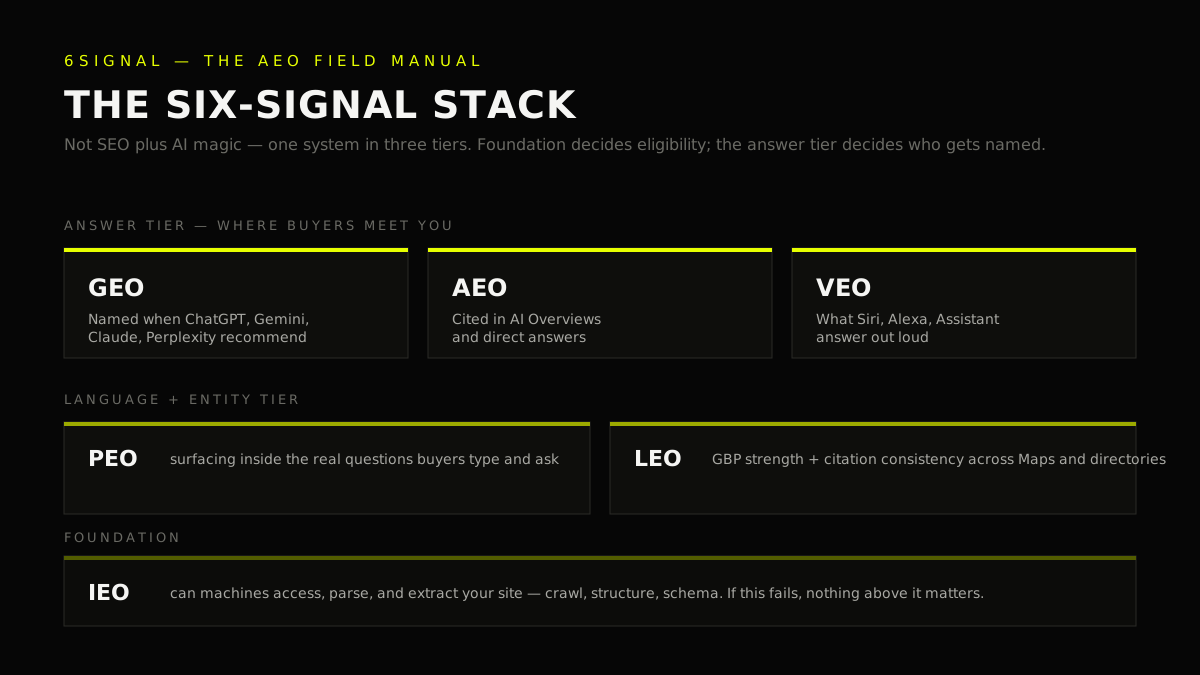
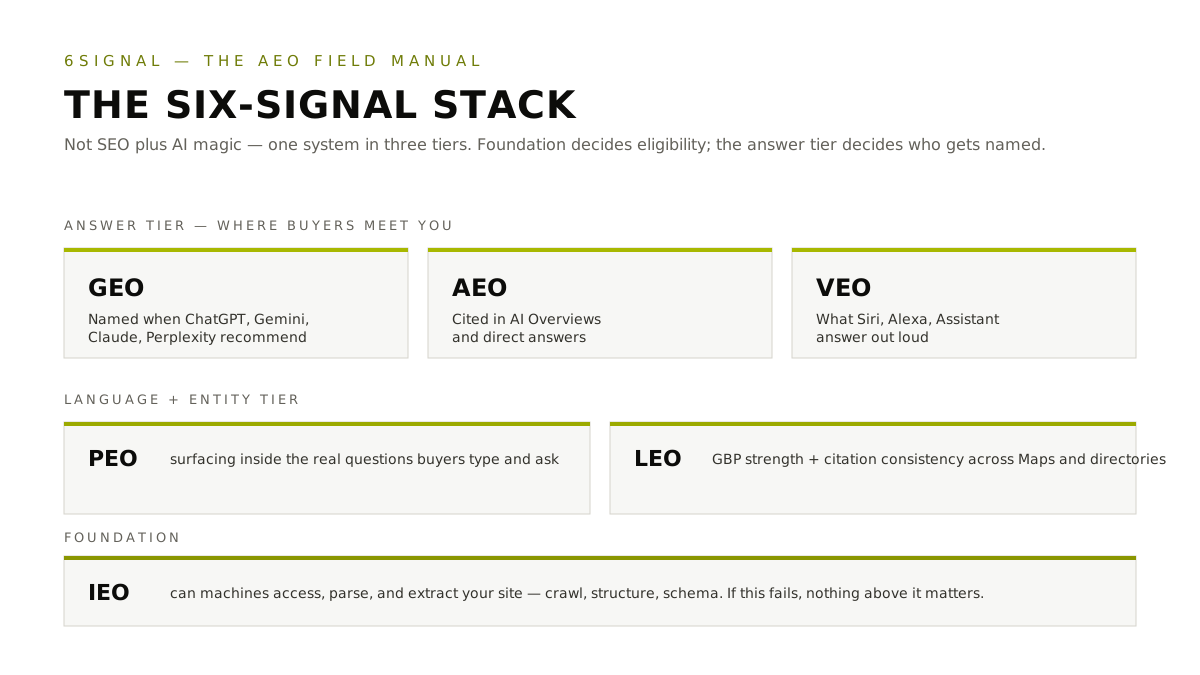
05 — The AEO Visibility Stack
AEO is a layered system. No single tactic produces answer-engine visibility — what produces it is the coherence of signals across ten distinct layers. A company that fixes only its schema while leaving entity data inconsistent, reviews thin, and content generic will see marginal improvement at best.
Below is the framework 6Signal uses to evaluate and build AEO visibility programs.
L-01 — Entity Clarity Can answer engines understand who the company is? This means a consistent, machine-readable entity: legal name, doing-business-as name, address, phone, website, founding date, service category, and key personnel — expressed identically across every digital surface and confirmed through multiple authoritative sources.
L-02 — Service and Offer Clarity Can answer engines understand what the company does and who it serves? Each service line should be described in plain, specific language — not marketing language. A plumbing company that says "we provide comprehensive plumbing solutions" gives AI nothing to work with. A plumbing company that says "we install, repair, and replace water heaters, sewer lines, and gas lines for residential and commercial clients in Tarrant County" gives the AI something to parse and cite.
L-03 — Question Coverage Does the company answer the high-intent questions buyers actually ask? This is not about FAQ pages. It is about structured question clusters — content that anticipates the full range of questions a buyer might ask at every stage of a decision, from diagnosis to vendor selection to post-service evaluation.
L-04 — Proof and Trust Signals Can the company be verified? Reviews, case studies, credentials, certifications, third-party mentions, project photos, and testimonials all function as verification signals. The specificity of reviews matters: "great service" is not a trust signal. "They replaced my main sewer line in one day and restored my yard afterward" is.
L-05 — Structured Data and Technical Readability Can machines parse the business, services, FAQs, breadcrumbs, authorship, locations, and content? Schema markup — including LocalBusiness schema, Service schema, FAQ schema, Review schema, and BreadcrumbList — gives AI systems direct, structured access to facts without requiring them to infer meaning from prose.
L-06 — Local and Market Relevance Is the company clearly tied to the geography, market, and category where it wants to be surfaced? This means Google Business Profile optimization, local citations, service-area pages, geo-specific content, and map presence — not as an afterthought but as a primary signal layer.
L-07 — Citation and Source Ecosystem Does the company appear in the places answer engines are likely to trust? Research from Profound (2025) found that platforms like ChatGPT and Perplexity frequently pull from Wikipedia, Reddit, YouTube, Quora, LinkedIn, and reputable industry directories. A company with no presence in these ecosystems is largely invisible to those engines.
L-08 — Content Architecture Is the company's expertise organized into a navigable, machine-readable structure? Service pages, question clusters, comparison pages, guides, case studies, and research assets should form a coherent information architecture — not a collection of loosely related blog posts.
L-09 — Multimedia and Human Signals Does the company have video content, transcripts, named experts, real project documentation, and founder or operator expertise on record? AI systems increasingly value human signals — real people, real knowledge, real proof — over generic content. A 3-minute video of a licensed plumber explaining how to identify a slab leak is worth more in AI visibility terms than five pages of generic content.
L-10 — Measurement and Iteration Is the company testing prompts, tracking citations, monitoring AI answers, and improving signals over time? AEO is not a one-time project. Search surfaces evolve, AI models update, and competitors improve. Measurement is how you know what is working and where to focus next.
06 — Keywords vs. Questions
Traditional SEO thinking starts with keywords. What terms do people type? How competitive are they? How do we rank for them?
AEO thinking starts with questions. What do buyers actually want to know? What problems are they describing? What decisions are they trying to make? The shift from isolated keywords to question clusters is one of the most concrete operational changes AEO requires.
| Keyword Thinking (SEO) | Question Thinking (AEO) |
|---|---|
| roof repair dallas | What should I do after hail damages my roof? |
| emergency plumber fort worth | Who should I call if a pipe bursts at night? |
| hvac repair plano | Why is my AC blowing warm air in July? |
| electrician arlington tx | How do I know if my wiring is dangerous? |
| foundation repair dfw | What are signs of foundation failure? |
The keyword version produces a ranked list that a buyer might scroll through. The question version produces a response the buyer might never need to leave. If your company answers the question with authoritative, specific, verifiable content, you have a pathway into that response.
Question Clusters
A question cluster is the full range of questions a buyer might ask around a single topic or decision. For a roofing company, the storm damage cluster might include: What should I do immediately after a hail storm? How do I tell if hail damaged my roof? Will my insurance cover hail damage? How long does a hail damage claim take? What does the roof repair process look like? How do I find a contractor I can trust?
A company that creates clear, specific, expert content answering every question in that cluster — organized into a coherent content structure — has dramatically higher odds of appearing across multiple answer engine responses than a company with a single "Storm Damage" service page and a phone number.
07 — How Answer Engines Choose What to Surface
The exact algorithms that determine what ChatGPT, Perplexity, Google AI Mode, and Gemini surface are not public. Anyone who claims otherwise is speculating. What can be observed — from public documentation, platform behavior, and the structure of these systems — is a set of signal categories that consistently appear to influence which sources get cited and which get skipped. These are practical working categories, not proven ranking factors.
Observed Signal Categories
| Signal Category | What It Means in Practice |
|---|---|
| Relevance | Does the company's content actually address the question being asked? Topic specificity, question-matching content, and semantic clarity all contribute. |
| Clarity | Is the information organized in a way that a machine can parse? Clear structure, defined terms, short answers followed by depth, and FAQ schema all help. |
| Authority | Does the company have credibility signals in its category? Credentials, years in business, professional associations, named experts, and authoritative third-party mentions all build authority. |
| Recency | Is the content current? Stale, outdated content is a liability. Regular content refreshes, updated service pages, and recent reviews all signal recency. |
| Consensus | Do multiple sources agree that this company is what it claims to be? Entity consistency across directories, review platforms, and third-party mentions creates consensus. |
| Structured Data | Has the company given machines direct, structured access to key facts through schema markup? |
| Third-Party Validation | Do credible external sources reference this company? Press mentions, industry directories, review aggregators, and social proof all function as validation. |
| Local Relevance | For local queries, is the company clearly tied to the right geography through GBP, local citations, service-area signals, and map presence? |
| User Intent Match | Does the company's content address not just the topic but the intent behind the query — informational, navigational, transactional, or comparison? |
| Source Quality | Is the site technically sound, fast, secure, and free of signals that suggest low-quality or manipulative practices? |
| Entity Consistency | Is the company's identity — name, address, phone, URL, category, description — consistent across every digital surface? |
The common thread: AI systems are trying to give users confident, verifiable answers. The companies that make that easier — by being clear, consistent, specific, and evidenced — appear more often. The ones that make it harder get skipped.
08 — AEO for Contractors and Local Service Companies
Local service companies and contractors are among the businesses most exposed to the answer-engine shift — and among the least prepared for it. The reason is structural. Contractor buyers are frequently in high-urgency, high-anxiety situations: making decisions under time pressure, with limited trade expertise, and real financial or safety stakes. That combination — urgency, risk, and limited information — is precisely the profile that drives buyers toward conversational AI search rather than traditional browsing.
The Moments That Matter
These are the types of queries that now route to answer engines before they route to search results — and where a named recommendation decides what happens next:
- "Who do I call if my sewer backs up on a Saturday night?" — Emergency, trust-critical, requires a named recommendation.
- "What should I do while waiting for an HVAC technician in a heat emergency?" — Diagnostic, high-anxiety, requires expert guidance and a credible source.
- "Is Riverside Roofing a reputable contractor?" — Verification query, trust-check, requires consensus across reviews and third-party sources.
- "What are the signs I need a new electrical panel?" — Diagnostic, educational, requires expert content that establishes the company's authority.
- "What does foundation repair typically cost in DFW?" — Transactional research, comparison-stage, requires structured price content or authoritative guidance.
- "Who handles commercial pest control in Fort Worth with same-day service?" — High-intent, specific, requires entity, service, and geography to all be clear and verifiable.
The AEO Gap in Contractor Markets
Most contractor websites were not built with any of this in mind. They have a homepage, a services page, a gallery, and a contact form. The entity data is inconsistent across directories. The reviews are either generic or absent. There is no question coverage, no FAQ schema, no video content with transcripts, and no structured service schema.
In traditional SEO terms, many of these companies do fine — they rank locally because of proximity signals and Google Business Profile authority. In AEO terms, they are largely invisible. The AI has no clear picture of who they are, what exactly they do, where they serve, or why they should be trusted over their competitors.
The Opportunity
The gap is also the opportunity. Contractor markets are not yet crowded with AEO-optimized competitors. The company in a given market that builds a clean entity, organizes its services clearly, gathers specific reviews, builds question clusters, and implements proper schema will have a meaningful early advantage — not forever, but long enough to matter.
This dynamic plays out identically across roofing, plumbing, HVAC, electrical, remodeling, garage door, tree service, pest control, foundation repair, and commercial contracting. The trades differ. The AEO gap is the same.
09 — AEO for Premium and Technical Brands
AEO is not a local-search discipline. Any brand operating in a category where buyers use AI to research, compare, and shortlist faces the same structural challenge — and the same gap between ranking and being named.
The Product Education Gap
Premium and technical brands often have deep expertise and thin content. The people who know the product best — engineers, founders, product leads, veteran salespeople — rarely have that knowledge in a structured, machine-readable, publicly accessible form. The AI cannot surface expertise that does not exist on the open web in a parseable format.
The strategic work for these companies involves building a content education layer: structured, attributed content that answers the questions buyers ask during evaluation. Comparison content. Use-case content. Full specifications. FAQ content that addresses real objections. Dealer discovery content. Support and troubleshooting documentation that also establishes category authority.
A premium outdoor equipment brand that builds thorough, expert content answering the questions buyers ask when comparing high-end gear — and structures that content with proper schema, clear authorship, and third-party citation signals — will appear in AI answers where a competitor with better products but weaker content infrastructure will not.
10 — The AEO Audit
An AEO audit is not an SEO audit renamed. It evaluates a different set of questions — though it includes technical SEO components as a prerequisite layer, not an afterthought.
Entity and Brand Clarity
- Business name, address, phone, and URL are character-for-character identical across Google Business Profile, website, Yelp, BBB, and all major directories
- The company's primary service category is specific and consistent — not generic (e.g., "sewer line repair and replacement" not "plumbing services")
- An entity description of 100–200 words exists on the website and is written in factual, machine-parseable language — no marketing superlatives
- Key personnel (owner, operators, licensed tradespeople) are named and publicly associated with the company on at least the website and GBP
Service Clarity
- Each distinct service has its own dedicated page — not a single combined "Services" page with brief bullets
- Each service page names the specific problem solved, the process used, who it serves, and the geography covered
- Service areas are specified by city, county, or zip code — not just "DFW area" or "North Texas"
- Pricing ranges, timelines, or process steps are included where possible — specificity builds machine trust
Technical and Structured Data
- LocalBusiness schema is implemented and accurate
- Service schema is implemented for each service line
- FAQ schema is implemented on all question-coverage pages
- Review schema is present and reflecting real review content
- BreadcrumbList, SiteLinks, and organizational schema are present
- The site is technically sound: fast, mobile-optimized, HTTPS, clean canonicals, valid sitemap
Question Coverage and Content Architecture
- The top 20–50 questions buyers ask in this category are identified and addressed
- Content is organized into question clusters by topic/service
- Comparison, guide, and case study assets are present
- Content is internally linked in a logical, navigable structure
- Content gaps are identified relative to competitor and AI-answer coverage
Proof and Trust Signals
- Google Business Profile is complete: hours, services, description, photos, and Q&A — updated within the last 90 days
- The company has 25+ Google reviews with an average of 4.2 or above; reviews mention specific services by name, not just general praise
- Active trade licenses, certifications, and professional associations are documented on the website with current credential numbers where applicable
- At least three case studies or completed-project write-ups are published, each describing the problem, the work performed, and the outcome
Citation and Source Ecosystem
- The company is present and consistent in major online directories (Yelp, BBB, Angi, HomeAdvisor, industry-specific)
- Third-party mentions, press coverage, or industry citations exist
- The company is mentioned on platforms AI systems are known to pull from (LinkedIn, YouTube, Quora, Reddit, etc.)
Multimedia and Human Signals
- Video content is present with transcripts published
- Named experts or operators are publicly associated with the company's content
- Real project proof (photos, documentation, outcomes) is publicly accessible
AI Visibility Testing
- The company has been tested across Google AI Mode, Perplexity, ChatGPT, and Gemini using at least 10 realistic buyer queries — not branded searches
- Results have been documented: which queries trigger a citation, which competitors appear instead, and which queries return no local recommendation at all
- A prompt-testing schedule is in place — at minimum monthly, with a consistent query set for tracking changes over time
- Citation gaps have been mapped to specific missing signals (entity, content, schema, reviews, third-party mentions) — not treated as a black box
11 — AEO Execution Roadmap
AEO is a phased program, not a one-time fix. The following roadmap represents a realistic, sequenced approach to building full AEO visibility.
Phase 1 — Baseline Visibility Audit Assess current standing across all search surfaces. Identify what the company looks like to AI systems today. Run prompt tests. Benchmark competitors. Document gaps.
Phase 2 — Entity Cleanup Standardize NAP (Name, Address, Phone) across all directories and platforms. Update Google Business Profile. Ensure entity consistency. Fix conflicting signals.
Phase 3 — Technical and Schema Cleanup Implement or repair structured data: LocalBusiness, Service, FAQ, Review, BreadcrumbList. Fix technical SEO issues. Validate sitemap and canonicals. Confirm mobile performance.
Phase 4 — Service-Page Refinement Rebuild or refine service pages for clarity, specificity, and machine readability. Each service should have a dedicated page with clear scope, target customer, geographic relevance, and FAQ section.
Phase 5 — Question-Cluster Content Architecture Build the question coverage layer. Identify the 30–60 highest-value questions buyers ask. Produce specific, expert content organized into question clusters by service or topic. Implement FAQ schema on all relevant pages.
Phase 6 — Proof and Citation Building Actively build trust signals: specific review solicitation, third-party directory submissions, credential documentation, case study production, press or industry mentions where accessible.
Phase 7 — Video and Human Expertise Assets Produce video content with published transcripts. Document operator or expert knowledge in structured, public-facing formats. Real expertise, visibly attributed, is a high-value AEO signal.
Phase 8 — Prompt and Answer-Surface Monitoring Establish a systematic prompt-testing protocol. Test the company's visibility across ChatGPT, Perplexity, Google AI Mode, and Gemini weekly. Track citations. Document changes. Monitor competitors.
Phase 9 — Monthly Iteration and Reporting Review what the AI systems are surfacing. Identify gaps. Update content, refresh reviews, adjust schema. AEO is an ongoing program, not a project with a finish line.
12 — Common AEO Mistakes
Treating AEO as just FAQ pages. FAQs are one minor signal in a 10-layer system. A company with clean FAQs, broken entity data, and generic reviews is not AEO-optimized.
Publishing AI-generated content at scale. Volume without expertise signals does not build authority. Generic content produced to fill gaps tends to dilute the quality signals that answer engines use to evaluate a source.
Letting entity data stay inconsistent. Conflicting NAP data across directories creates ambiguity about which entity a company actually is. That ambiguity costs citations. This is frequently the first thing to fix — and the most overlooked.
Optimizing only the website. Answer engines pull from the full digital ecosystem: directories, reviews, YouTube, LinkedIn, industry publications, Reddit. A well-structured website surrounded by a thin citation ecosystem is still largely invisible.
Collecting generic reviews. "Great company, highly recommend" is not a trust signal. "They replaced my main water line in Keller in one day and restored the yard" is. Review quality — not just review count — affects what AI systems can extract and cite.
Equating rank position with recommendation visibility. These are measured differently, optimized differently, and mean different things to buyers. A company can hold position one and be absent from every relevant AI answer.
Using promotional language where factual language is needed. Claims like "best in DFW" and "most trusted" are noise. AI systems extract verifiable facts — credentials, service scope, geography, outcomes. Write for machines first, then refine for humans.
Losing the buyer after the citation. AEO visibility that sends buyers to a slow, unclear, or conversion-free page wastes the referral. Every answer-engine-optimized asset needs a logical next step.
Skipping video. A 3-minute video of a licensed technician explaining a real problem — with a published transcript — carries more human expertise signal than ten static FAQ pages. It is underused in every contractor market we have evaluated.
Running AEO without measuring it. If you are not testing prompts and documenting citations systematically, you cannot know what is working. Measurement is how AEO compounds over time instead of plateauing after the initial build.
13 — What Winning Looks Like
A mature AEO program does not guarantee citations. No honest practitioner should promise that. What it produces is a company the AI systems find easier to verify, cite, and recommend than its competitors — which means it appears in more answers, in more markets, across more query types, compounding over time.
In concrete terms, a company with a functioning AEO system looks like this:
- Its entity is identical across every surface an AI system might read — no conflicting names, addresses, phone numbers, or categories
- Every service is described specifically, with schema that machines can parse without inferring from prose
- It has expert content covering 40–60 questions buyers actually ask — organized by topic, not by publication date
- Its reviews are recent, specific, and name real services — not a collection of five-star blanket endorsements
- It appears consistently in the directories and third-party platforms that answer engines pull from
- Its technical infrastructure is clean: fast load, mobile-optimized, valid schema, no broken signals
- Named operators or licensed tradespeople are on record — in video, in content, in reviews — so the expertise is attributable, not anonymous
- Someone runs a prompt-testing protocol at least monthly and tracks citation changes against content and schema updates
- Content is refreshed on a schedule, not abandoned after publication
"No AEO program guarantees a citation. But a company that is clear, consistent, verified, and expert will appear in more AI answers than one that is not — and that gap compounds."
14 — The 6Signal Point of View
AEO is not manipulation. It is not a set of tricks to insert a company name into AI responses. It is structural clarity — the work of making a business easy for machines to read, verify, and cite with confidence.
The companies that perform best in the AI search layer are not the ones that reverse-engineer algorithms. They are the ones that do the unglamorous work of being clear: about who they are, what they do, where they operate, and why they should be trusted. That clarity existed as a business requirement long before AI search — AI simply makes its absence visible.
Most of the published conversation around AEO and GEO centers on SaaS companies, e-commerce brands, and media publishers. That is where the researchers and software vendors are. It is not where the exposure is sharpest. A roofing company fielding storm-damage calls, a plumbing contractor competing for emergency service jobs, a commercial HVAC company trying to win facility management accounts — these businesses are operating in high-intent categories where buyers are already turning to AI, and where the AEO gap is almost universally unaddressed.
That is who 6Signal is built for. And the work is not exotic. It is entity cleanup, service-page precision, question cluster architecture, review specificity, schema implementation, and disciplined measurement — applied to the real conditions of contractor and local service markets.
SEO is not ending. The answer layer is growing on top of it. The companies that build both — a solid traditional search foundation and a clear, verified, structured AEO system above it — will be better positioned regardless of how AI search evolves from here.
Search used to be a list. Now it is becoming a shortlist. We help companies get on it.
Two companion works have joined this manual since publication: Google's official AI-features guidance confirmed the fundamentals-first position — our analysis of what it changed — and the AI Search Measurement Playbook turns the visibility question into a logged, repeatable protocol.
AEO Action Checklist
A quick-reference starting point. Use this before requesting a full audit — it shows you where the work begins.
Fix First (Foundation)
- Business name, address, and phone are identical across Google Business Profile, website, Yelp, BBB, and all major directories — character for character
- Google Business Profile is verified, complete, and updated in the last 90 days — services, hours, photos, and description all present
- LocalBusiness schema is implemented in JSON-LD and validated with Google's Rich Results Test
- The site loads in under 3 seconds on mobile, has a valid SSL certificate, and returns a clean sitemap with no broken canonical tags
Build Next (Signal Layer)
- Each service has its own dedicated page — not a tab or a bullet on a combined services page
- Service schema is implemented for each service line with specific description, provider, and area served fields completed
- FAQ schema is implemented on all service and question-coverage pages
- At least 25 Google reviews exist with an average of 4.2+; recent reviews name specific services performed
- The company is listed and consistent in Yelp, BBB, Angi, and any relevant trade-specific directories
- Active licenses, certifications, and professional associations are documented on the website
Build Out (Answer Layer)
- The top 30–50 questions buyers ask in your category are identified and each has a published, expert answer
- Question content is organized into topical clusters — not scattered blog posts
- At least one video per service exists, with the transcript published on the same page
- Named operators or licensed personnel are credited in content and visible in reviews
- The company has been tested in ChatGPT, Perplexity, Google AI Mode, and Gemini using buyer-intent queries — results documented
- A prompt-testing schedule is in place with a consistent query set to track citation changes month over month
6Signal Visibility Audit
// 6Signal Visibility Audit
Find Out Where You Get Skipped.
We run your company through Google AI Mode, Perplexity, ChatGPT, and Gemini using the questions your buyers actually ask. You see exactly where you appear, where competitors get named instead, and which signals are causing the gap. The audit produces a prioritized fix list — not a strategy deck. No fluff. No retainer pitch. A real picture of your AI visibility and a clear starting point.
Request Your Visibility Audit →
Sources and Further Reading
- Ahrefs. (2025). Google AI Overviews appear in 54%+ of U.S. search queries. Ahrefs Research.
- Conductor / Besmertnik, S. (2025). AEO/GEO Benchmarks Report. ALM Corp analysis. almcorp.com.
- Elon University / Imagining the Internet Center. (2025). Survey data on U.S. adult LLM usage cited in multiple 2025 AEO research summaries including AirOps and Bullseye Strategy analyses.
- Gartner. (2025). Prediction: Traditional search engine volume to decline 25% by 2026 as AI tools absorb query load.
- Google Search Central. developers.google.com/search — Structured data documentation, schema markup guides.
- HubSpot / Patel, N. (2025–2026). Answer Engine Optimization Trends 2026. blog.hubspot.com/marketing/answer-engine-optimization-trends.
- Pew Research Center. (2025). Click-through behavior with/without AI overview present: 8% vs 15%.
- Profound. (2025). AI Citation Source Study: ChatGPT and Perplexity citation sources include Wikipedia, Reddit, YouTube, Quora, LinkedIn. tryprofound.com.
- Schema.org — Full schema vocabulary and LocalBusiness, Service, FAQPage specifications. schema.org.
- Semrush. (2025). Reported higher conversion rates from AI search referrals relative to traditional search in early platform data. Full methodology not published.
- The Growth Memo. (2025). Average ChatGPT prompt length: 23 words vs 3.37 words in traditional search. Cited in HubSpot AEO analysis.