Executive summary
Local visibility used to be a marketing activity: rank in the map pack, buy some ads, keep the phone ringing. It is becoming something structurally different — infrastructure. When a buyer asks Google's AI features, ChatGPT, Perplexity, Gemini, Siri, or Alexa who to call, the machine assembling that answer reads a set of records about your business: your Business Profile, your service pages, your reviews, your directory listings, your markup, and the third-party pages that corroborate (or contradict) all of the above.
If those records are complete, consistent, and specific, the machine can find you, verify you, and confidently include you in answers. If they're thin, stale, or contradictory, the machine doesn't argue with you. It just picks someone easier to verify.
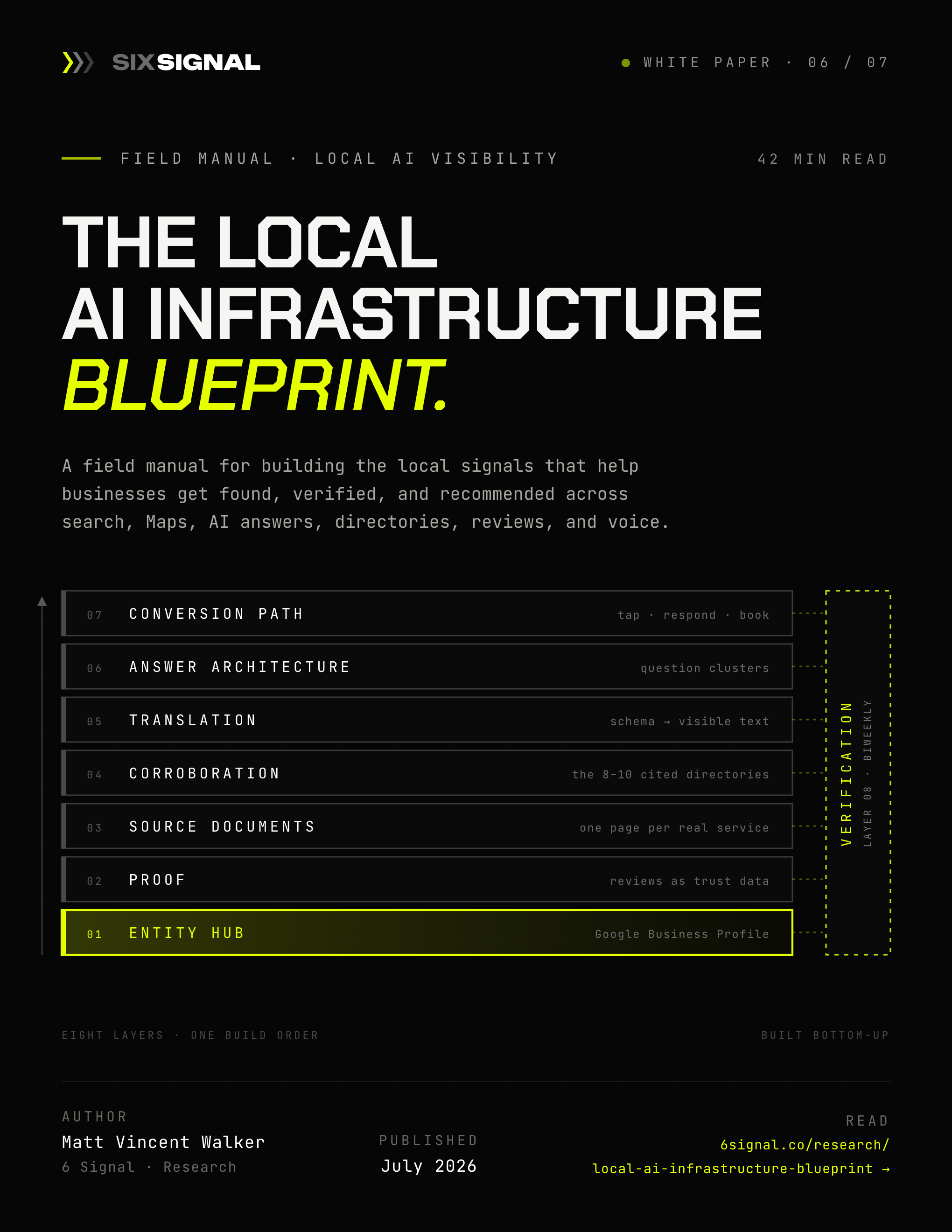
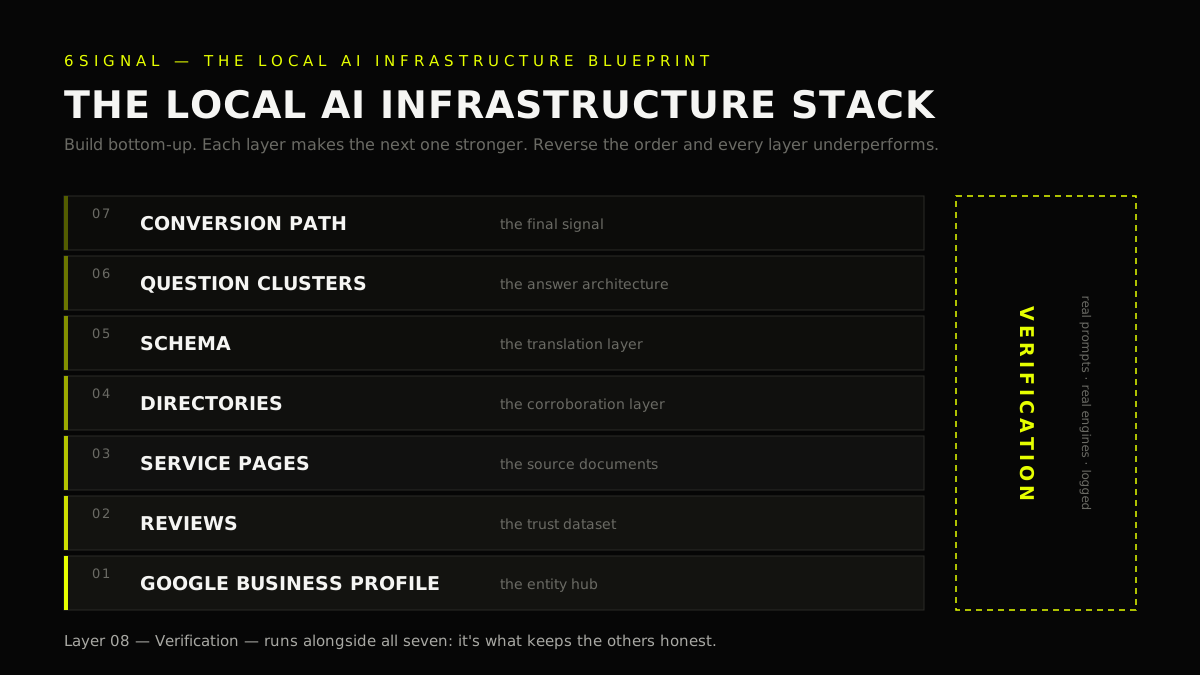
This blueprint treats local AI visibility the way an engineer treats infrastructure: as a stack of eight interdependent layers — entity hub, proof, source documents, corroboration, translation, answer architecture, conversion path, and verification — with a defined build order, trade-specific applications, a 90-day implementation sequence, and an audit checklist. No layer is exotic. The advantage comes from building all of them, in order, and keeping them in agreement — which almost no local business currently does.
Short answer
Local AI infrastructure is the set of machine-readable records that lets any engine answer four questions about your business without guessing: who are you (entity clarity: consistent name, categories, services, service area), what's the evidence (reviews and third-party corroboration), what do you actually do (service pages that function as source documents), and can a buyer act (a conversion path that turns visibility into booked work). Google Business Profile is the entity hub; reviews are the trust dataset; service pages are the source documents; directories are corroboration; schema is the translation layer; question clusters are the answer architecture; the conversion path is the final signal; measurement verifies the whole stack. Build them in that order — each layer makes the next one stronger.
Part 1: Why local businesses are exposed
Three structural facts put local service businesses at particular risk in AI-mediated search:
First, local queries are exactly the kind AI surfaces compress. "Best roofer in Waxahachie" doesn't produce ten links anymore for a growing share of buyers — it produces a paragraph naming two or three companies. The economics of being unnamed are absolute: for that buyer, in that moment, you don't exist. We covered the mechanism in Why AI Search Skips Better Contractors — and the uncomfortable finding is that the skipped business is often better at the trade and merely worse at being legible.
Second, local businesses run on thin, inconsistent records. The average contractor's public data — profile, site, directories — was assembled over a decade by different vendors, none of whom reconciled it. Humans forgive that mess. Retrieval systems don't; inconsistency reads as low confidence, and low confidence gets skipped.
Third, the trust burden is higher. Recommending a hair salon carries low stakes. Recommending someone to cut a hole in your roof carries real stakes, and answer engines behave accordingly — leaning on review evidence, corroboration, and verifiable specifics before naming trade businesses. The bar is higher exactly where the records are weakest.
The exposure is the opportunity. Because most local competitors' records are equally bad, the first business in a market to build real infrastructure gets an outsized share of the answers.
Part 2: The stack, layer by layer
Layer 1 — Google Business Profile: the entity hub
GBP is the one structured record about your business that Google guarantees machines will read, and Google's own AI-features guidance tells owners to keep Business Profile information current — a plain statement that profile data feeds AI surfaces, not just the map.
The ranking mechanics remain Google's stated three: relevance ("how well a Business Profile matches what someone is searching for"), distance, and prominence ("how well-known a business is," informed by links, reviews, and ratings). And the sentence that should end several sales calls: "There's no way to request or pay for a better local ranking on Google."
As infrastructure, the profile's job is entity definition: exact name (no keyword stuffing — it violates Google's representation guidelines), correct primary category, every honest secondary category, every service enumerated, true service area, aligned hours/phone/site. The full treatment is in Google Business Profile Is Becoming Local AI Infrastructure.
Layer 2 — Reviews: the trust dataset
Machines read reviews twice. Once as numbers — count, rating, velocity, recency — feeding prominence. And once as text — which is where most operators miss the leverage. A review that says "fixed our slab leak in Waxahachie same day, honest about the price" is machine-readable evidence binding service + location + trust attribute to your entity. Fifty reviews that say "great company!" bind nothing to anything.
Infrastructure practice: a permanent post-job ask (not a burst campaign), a nudge toward specificity ("mention what we fixed and where, if you don't mind"), and a response to everything. The detailed model is in Reviews Are AI Visibility Data and What Contractor Reviews Need to Say.
Layer 3 — Service pages: the source documents
When an engine needs facts about what you do — scope, area, cost drivers, response time — your service pages are the documents it reads. Most contractor service pages were written as brochures ("quality you can trust since 1998") and contain almost nothing extractable.
A source document answers, in visible text, near the top: what the service covers, where you provide it, who it's for, what drives the price, how fast you respond, and why you're credible (license, years, review evidence). One page per real service — not one "Services" page listing nineteen things in a paragraph. The template is How to Build an Answer-Ready Service Page.
Layer 4 — Directories: the corroboration layer
Engines cross-check. When your site, your profile, and Yelp/Angi/BBB/the local chamber all state the same name, phone, services, and area, each record corroborates the others and entity confidence rises. When they disagree, confidence falls — and there's a second, blunter effect: for many local queries, engines cite the directories themselves. If the answer to "best plumber in Red Oak" is being assembled from a directory you're not on (or are wrong on), you've lost upstream of your own website. This is why directories and aggregators keep winning AI answers.
Infrastructure practice: identify the 8–10 directories engines actually cite in your market (your measurement layer tells you this — don't guess), fix those first, kill dead listings, and stop paying for the long tail nobody cites.
Layer 5 — Schema: the translation layer
Structured data doesn't create authority; it removes ambiguity from authority you already have. Google's framing is exact: markup helps machines understand page content, and its one AI-relevant instruction is that structured data must match the visible text. The stack for a local trade: LocalBusiness (correct subtype) as the site-wide entity anchor, Service per service page, FAQPage wrapping visible Q&As, BreadcrumbList for hierarchy. Deployed on thin pages, schema translates emptiness fluently — which is why it's layer five, not layer one. Full argument: Schema Is Not a Hack. It Is a Translation Layer.
Layer 6 — Question clusters: the answer architecture
Buyers ask machines full questions, and generated answers get assembled from content shaped like answers. A question cluster — a core service page surrounded by pages each owning one substantial buyer question, interlinked — is the content architecture that matches how the surface works. FAQs alone are a checkbox; clusters are comprehensive authority. Build them from real questions (call logs, reviews, People Also Ask), prioritize by distance-to-phone-call, and keep every answer locally honest. See Question-Form Search Is the AEO Opportunity and Question Clusters: The Content Architecture of AEO.
Layer 7 — Conversion path: the final signal
Infrastructure that wins the answer and loses the phone call is a monument, not a system. The conversion layer: a phone number that's tappable and immediate on every page, response speed that matches the promise ("24/7" claims with voicemail-only weekends are trust debt), booking that works on a phone at 9 PM, and a follow-up path for the lead who isn't ready today. There's also a signal effect: engines increasingly weigh experience quality, and a page that buyers bounce off is evidence against you. Conversion isn't after visibility; it's the last layer of visibility.
Layer 8 — Verification: the layer that keeps the others honest
A fixed buyer-language prompt set, run across ChatGPT, Perplexity, Gemini, Google AI surfaces, and Maps on a fixed cadence, logged consistently. Not for the dashboard — for the routing: every persistent gap indicts a specific layer above. The complete method is the AI Search Measurement Playbook.
Part 3: The build sequence
Order matters because each layer feeds the next. The dependency logic:
- Verification baseline first (you can't route fixes without it)
- Entity hub (everything downstream reads from it)
- Proof (reviews take time to accumulate — start the engine early)
- Corroboration (align the records the engines already cite)
- Source documents (rebuild the money pages)
- Answer architecture (clusters around the top service)
- Translation (schema over content that's now worth translating)
- Conversion (tighten the path the new visibility feeds)
- Re-verify (same prompts, same engines — the honest before/after)
Reversing this order is the most common self-inflicted wound: schema plugins on brochure pages, review campaigns pointing at a profile with wrong categories, content sprints for an entity engines can't confidently identify.
Part 4: Trade-specific applications
The stack is universal; the emphasis isn't.
- Emergency-dominant trades (plumbing, HVAC repair, garage doors, electricians on service calls): buyers ask "who can come now" — decision prompts dominate. Weight GBP hours accuracy, review recency, response-speed proof, and call-path friction. A cluster on emergencies ("burst pipe — what do I do first?") captures the panic query that precedes the hire.
- High-consideration trades (roofing, remodeling, foundation repair, commercial GC): buyers research for weeks — problem prompts and verification prompts dominate. Weight question clusters (insurance, repair-vs-replace, cost drivers), review specificity over raw velocity, and third-party corroboration, because these buyers cross-check everything.
- Recurring-service trades (landscaping, pest control, tree service): comparison shopping on price and reliability. Weight service-area breadth (town coverage), plan/pricing clarity on pages, and volume of location-tagged reviews across the whole territory, not just the home base.
Part 5: The 90-day implementation roadmap
The compressed version — the full week-by-week sequence with exit criteria is published separately as The 90-Day AI Visibility Roadmap for Contractors:
- Weeks 1–2: baseline — prompt set built, all engines tested, site crawl, numbers snapshotted.
- Weeks 3–4: entity hub — GBP corrected, completed, aligned with the site.
- Weeks 5–6: proof + corroboration — review engine installed, top directories reconciled.
- Weeks 7–8: source documents — top two or three service pages rebuilt answer-ready.
- Weeks 9–10: answer architecture — first question cluster live around the #1 service.
- Week 11: translation — schema deployed and validated; internal links tightened.
- Week 12: re-verify — identical prompt set, deltas recorded, cycle two prioritized from the gaps.
Ninety days builds one full pass of the stack. It doesn't finish the practice — infrastructure is maintained, not completed.
Part 6: The audit checklist
Score each item yes/no. Every "no" is a work order.
Entity hub: primary category correct · all honest secondary categories · every service enumerated · true service area · name/phone/hours identical to site · 15+ real photos · owner-seeded Q&A.
Proof: review ask fires after every job · last review under 30 days old · reviews name services and towns · every review has a response · rating ≥4.5 with volume competitive for the market.
Source documents: one page per money service · what/where/who/cost-drivers/response-time visible near the top · buyer language, not brochure language · license and proof present.
Corroboration: top 8–10 cited directories identified from measurement · NAP identical across them · dead listings removed.
Translation: LocalBusiness subtype site-wide · Service + FAQPage on money pages · markup matches visible text · validates clean · no conflicting duplicate declarations.
Answer architecture: 8+ real buyer questions answered substantively · interlinked to parent services · every town in the service area has a page or section.
Conversion: tap-to-call above the fold on mobile · after-hours path honest · booking works on a phone · sub-hour response during stated hours.
Verification: frozen prompt set · five engines · biweekly · logged with mention/position/competitors/sources · last cycle produced at least one work order.
Common mistakes
- Tactic shopping — buying layers in random order from different vendors who never reconcile them. The stack's value is agreement between layers.
- The set-and-forget profile — treating GBP as a 2019 setup task while it quietly became your entity record.
- Review bursts — 30 reviews in March, silence until November. Machines read recency; bursts read as campaigns.
- Brochure pages with schema on top — translating content that says nothing.
- Directory maximalism — paying for 60 listings when the engines in your market cite eight. Corroboration needs the right records consistent, not the most records.
- Winning answers, losing calls — no one owns the conversion path, so infrastructure fills a bucket with a hole in it.
- No verification layer — shipping all of it and never testing a single real buyer prompt against a single real engine.
What to fix first
If you do exactly three things this month: (1) run a one-afternoon baseline — fifteen buyer prompts across five engines, logged; (2) complete and correct your Google Business Profile until it agrees with your website word for word; (3) install the permanent review ask. Those three touch the hub, the proof, and the truth — and they make every subsequent layer measurably stronger.
What this means for operators
You are not being asked to become a marketer. You're being asked to treat your public records the way you treat your trucks and tools: as operating infrastructure that either works or doesn't. The businesses that internalize this in the next couple of years will compound quietly in every answer surface their market uses. The ones that don't will keep wondering why the phone is slower while their reviews are better than the company getting named.
Limitations and caveats
No layer of this stack guarantees inclusion in any answer, ranking, or AI feature — no such mechanism exists, and Google says so explicitly for its own surfaces. Engines change retrieval behavior without notice; the stack is designed to be robust to that (fundamentals + verification), not immune. Timelines vary by market density and competitive baseline: a solo plumber in a small market can move visibly in one 90-day cycle; a roofer in a saturated metro should expect two or three. And infrastructure decays — records drift, reviews age, competitors build. This is maintenance, not a monument.
Build it with us
The Visibility Audit is the first two weeks of this blueprint executed for you: full baseline, all six signals scored, the stack audited layer by layer, and the 90-day sequence prioritized for your market.
Sources and further reading
- Google Business Profile: How to improve your local ranking — support.google.com/business/answer/7091
- Google Business Profile: Guidelines for representing your business — support.google.com/business/answer/3038177
- Google Search Central: AI features and your website — developers.google.com/search/docs/appearance/ai-features
- Google Search Central: Introduction to structured data markup — developers.google.com/search/docs/appearance/structured-data/intro-structured-data
- Google Search Essentials — developers.google.com/search/docs/essentials
- Schema.org: LocalBusiness and Service type definitions — schema.org
- 6Signal: The AEO Field Manual — /research/aeo-field-manual-answer-engine-optimization