The Question Cluster Advantage: How to Structure Content for the Shift from Search Rankings to AI Answers
A 6Signal White Paper Published May 2026
Executive Summary
Most companies are not losing visibility because their SEO is broken. They are losing it because their content was built for a search environment that no longer fully describes how buyers find information.
For two decades, digital visibility was a ranking problem. Find the keywords with volume. Build pages around those keywords. Earn links. Win position. That model rewarded a specific kind of content: keyword-dense, individually optimized, designed to rank pages in isolation.
That model is not dead. But it is no longer sufficient.
Search behavior has bifurcated. A measurable and growing share of queries — particularly decision-stage queries with high commercial intent — now route through AI-powered answer surfaces: Google AI Overviews, Perplexity, ChatGPT, Gemini, and voice assistants. These systems do not return a ranked list of links. They synthesize answers from multiple sources and present a single response. The companies that appear in those responses are not always the ones with the highest keyword rankings. They are often the ones whose content is most precisely organized around the question being asked.
This is a visibility infrastructure problem. Random FAQ sections are not the solution. Publishing more blog posts is not the solution. The solution is question cluster architecture — a deliberate content structure built around the full set of questions a buyer asks before they trust, compare, and choose a company.
This white paper defines what question clusters are, distinguishes them from adjacent concepts that are frequently conflated with them, and explains how to build a question cluster system that serves traditional search rankings, Answer Engine Optimization (AEO), and Generative Engine Optimization (GEO). It is written for contractors, home service companies, technical brands, and marketing leaders who want a content strategy built to last — not to exploit the current algorithm.
What Is a Question Cluster?
A question cluster is an organized group of buyer questions tied to a specific decision — not a keyword, not a topic category, and not a service line. It is the complete set of questions a buyer works through between the moment they recognize a problem and the moment they commit to a company.
The distinction matters. A keyword captures what someone types. A topic clusters related keywords under a subject umbrella. A question cluster maps the actual cognitive work of a buyer moving through a decision: What is wrong? How serious is it? Who can fix it? What will it cost? What does the process look like? Who do I trust? How do I start?
Question clusters are not blog posts organized loosely around a theme. They are not FAQ sections bolted onto a service page. They are visibility infrastructure — a structured set of pages and answers covering every meaningful point of buyer uncertainty, linked together in a way that reinforces topical authority for search systems and provides coherent source material for AI-generated responses.
A question cluster does not describe what you do. It maps what your buyer needs to know before they decide to hire you.
When that architecture is built with precision — real buyer questions, direct specific answers, clean internal links, accurate schema — it serves Google rankings, AI Overviews, answer engines, and the buyer simultaneously. When it is built without precision, it produces the appearance of content without the function of it.
The Shift: From Keywords to Buyer Questions
How Traditional SEO Was Built
Traditional SEO was engineered around the keyword: the word or phrase a person types into a search engine. Volume, competition, and ranking position defined success. Content strategy was often reverse-engineered from keyword data — identify high-volume terms, build pages targeting those terms, iterate.
Keywords are not irrelevant. They carry legitimate signal about buyer intent. They belong in well-structured content. Keyword research remains a foundational practice. But keywords were always a proxy for something more precise: the questions buyers have and the decisions they are trying to make. The keyword was the closest approximation available when the data source was a search bar.
Why AI Search Requires a Different Architecture
The behavioral gap between keyword search and AI-assisted search is measurable. The average traditional search query is approximately 3.4 words. The average AI prompt runs closer to 23 words — a sevenfold difference. That gap reflects a fundamental change in what users are doing: they are not retrieving a link list, they are asking for an answer.
"My roof has hail damage and my insurance adjuster is coming Friday — what should I do and what questions should I ask?" is not a keyword. It is a question with context, urgency, and a specific decision embedded in it. Google AI Overviews, Perplexity, ChatGPT, and Gemini are built to process that kind of input. They extract relevant information from sources across the web, synthesize a response, and surface citations — often without the user clicking through to any individual page.
In this environment, what earns visibility is not a page optimized for a keyword. It is content structured to answer a question precisely, within a coherent topical context. AI systems evaluating your content are not counting keyword frequency. They are evaluating signal clarity — whether the content is organized, extractable, accurate, and directly relevant to the question at hand.
Content architecture built around keywords produces pages. Content architecture built around buyer questions produces answer surfaces. AI search rewards the latter.
The Problem With Random FAQs
The surface-level response to AI search — "add FAQ sections" — is not wrong in principle. It is incomplete in a way that often does more harm than good.
Thin FAQ pages built around generic questions, populated with answers that could apply to any company in any market, do not build authority. They produce pages with minimal unique value that search systems have consistently learned to discount. Google's guidance on helpful content is explicit: content that exists primarily to appear useful — rather than to be useful — is not rewarded.
The deeper problem is not format. It is architecture.
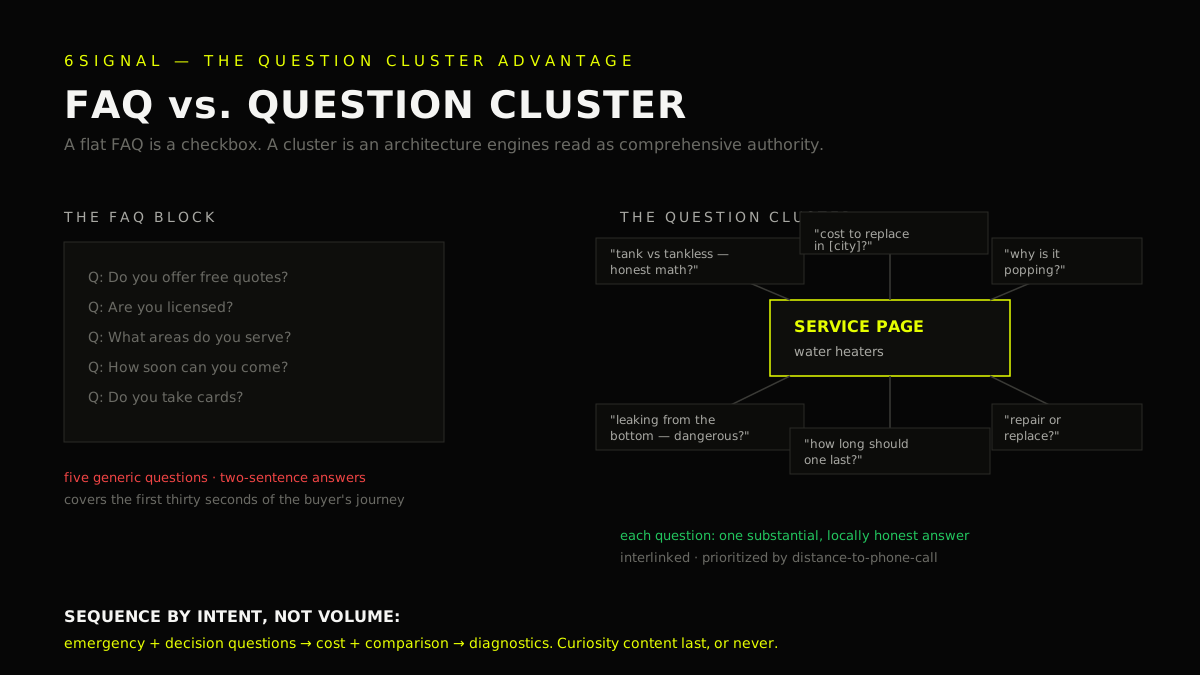
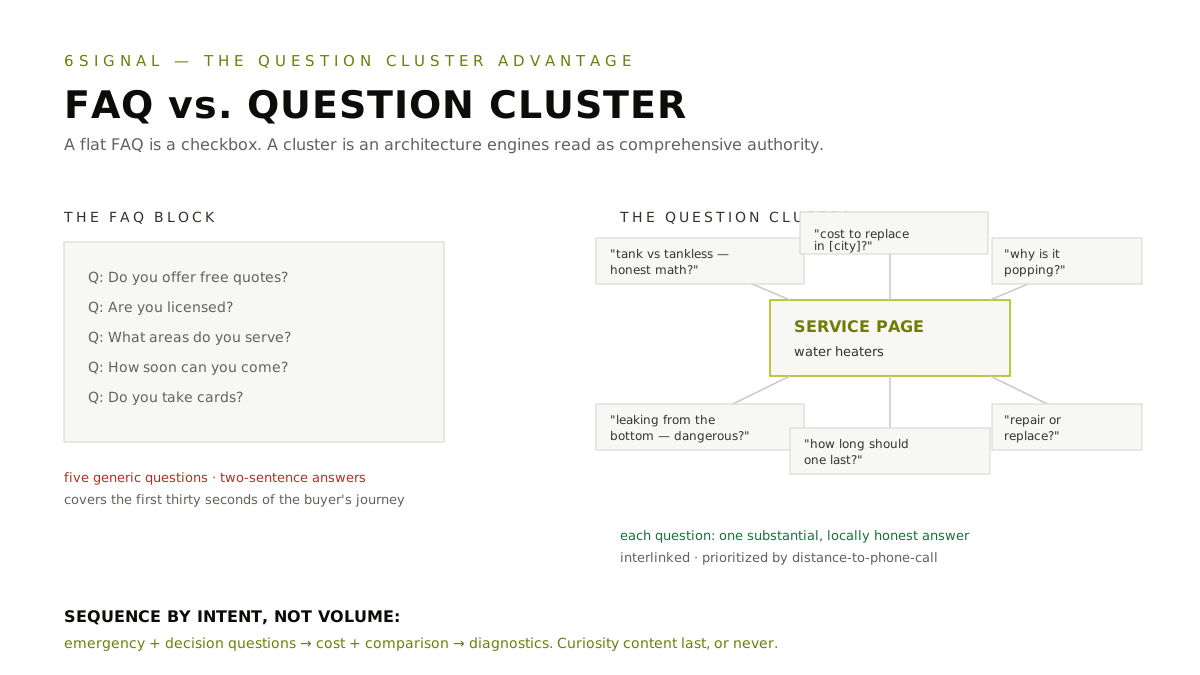
A random FAQ is a question without a decision attached to it. A question cluster is a set of questions organized around a specific buyer decision — where every question connects to that decision, every answer moves the buyer forward, and every page links to the others in a coherent structure. The cluster serves the buyer's actual research process. The random FAQ serves the appearance of one.
The difference is not visible in a content audit that counts pages. It is visible in whether a buyer who lands on your site at 11 p.m. — trying to decide whether their water heater needs to be replaced or just repaired — can find a complete, honest, specific answer set and a clear path to call you in the morning.
The issue is architecture, not volume. More questions are not the answer. Better organized ones are.
Keywords, Topics, and Question Clusters: A Precise Vocabulary
These terms appear together in most content marketing discussions and are used interchangeably in most of them. They should not be. Each describes a different level of abstraction, a different unit of strategy, and a different relationship to buyer intent.
Keyword: A word or short phrase used as the primary targeting unit in traditional SEO. Keywords describe what buyers type, but not what they mean, what decision they are in the middle of, or what kind of answer would actually serve them.
Topic: A subject area — broad, categorical. "Roofing" is a topic. "Water heaters" is a topic. Topics are the organizing umbrella under which many keywords live.
Topic cluster: A content architecture designed to build topical authority. Typically structured as a pillar page covering a broad topic, supported by cluster pages covering related subtopics. Topic clusters build subject-matter depth and signal expertise to search systems — but they are organized around subjects, not decisions.
Question: A specific expression of buyer intent. Where a keyword signals a subject area, a question reveals the nature of a buyer's concern — a problem they are trying to diagnose, a cost they are trying to understand, a trust decision they are working through, or a readiness to act. Questions are where intent becomes legible.
Question cluster: An organized group of buyer questions built around a single buyer decision. Not a collection of FAQs. Not a blog editorial calendar. A deliberate buyer decision architecture that maps the decision journey — from the moment a buyer first recognizes a problem through the moment they commit to a company — and builds direct answers at every meaningful point along that arc.
Buyer decision: The specific choice a buyer is trying to make. "Should I repair or replace my roof?" is a buyer decision. "Which commercial HVAC vendor should I trust for our facility upgrade?" is a buyer decision. Question clusters are organized around decisions, not around company service lines. The distinction matters: organizing content around your services reflects how your company thinks about what it sells. Organizing content around buyer decisions reflects how your buyer thinks about what they need.
Search intent: What a user is trying to accomplish with a query. Traditional SEO intent categories — informational, navigational, transactional — describe the type of action a user is taking.
Answer intent: A more granular construct specific to AEO. Answer intent describes the kind of answer a buyer expects — a definition, a cost range, a process explanation, a comparison, a qualification check, a recommendation. Content built for answer intent is structured to satisfy the question directly and specifically. A page optimized for the keyword "roof replacement cost" may rank in traditional search. A page built for the answer intent of "how much does a full roof replacement cost in [city], and what does insurance typically cover?" is structured to be cited by an AI system answering that exact question for a specific buyer.
The 6Signal Question Cluster Model
The 6Signal Question Cluster Model organizes buyer questions into seven sequential layers, following the arc of a decision journey. Buyers do not move through these layers in a straight line — a single search session may touch three or four simultaneously, and a buyer researching a complex project may revisit earlier layers after new information changes their understanding. The framework is not a funnel. It is a map of buyer intent coverage.
Its value is completeness. Most company websites answer the questions that companies want to answer. Question clusters are built around the questions buyers actually ask — including the uncomfortable ones about cost, the skeptical ones about trust, and the logistical ones about process that often determine whether a buyer calls at all.
Layer 1: Trigger Questions
What they are: The initiating questions that open a search journey — arising the moment a buyer recognizes a problem, notices a symptom, experiences a failure, or encounters a new need.
Why they matter for SEO, AEO, and GEO: At the trigger layer, buyers have not yet formed a preference for any company. Being present clearly and usefully at this layer builds the first association between your expertise and the buyer's problem. For AI search, trigger questions often serve as the opening prompt in longer conversational threads. The company whose content frames the first answer shapes the context for all the questions that follow. Owning this layer in your market is an early-stage visibility signal with compounding effect.
Contractor example: "Why is my AC running but not cooling the house?" / "What does hail damage look like on an asphalt shingle roof?"
Technical/premium brand example: "What causes hydraulic pump failure in commercial equipment?" / "How do I know when to replace an industrial chiller instead of repairing it?"
Layer 2: Diagnostic Questions
What they are: Questions buyers ask to understand the scope, cause, and severity of their problem — and to determine whether they need professional help or can address it themselves.
Why they matter: Diagnostic content is where expertise is demonstrated before trust is requested. It positions a company as authoritative during the research phase, when the buyer has no commercial intent yet and is most receptive to expert framing. AI systems consistently favor diagnostic content because it is specific, factual, and cleanly extractable — the kind of structured usefulness a generative system can cite credibly in response to a "how do I know if..." query.
Contractor example: "What are the warning signs of a slab leak under a concrete foundation?" / "How do I know if my electrical panel is overloaded or unsafe?"
Technical/premium brand example: "What are the symptoms of bearing wear in a commercial refrigeration compressor?" / "How do I diagnose low superheat in a large commercial HVAC system?"
Layer 3: Trust Questions
What they are: Questions buyers ask to determine whether a company, technician, or product is credible, licensed, insured, and safe to hire or purchase.
Why they matter: Trust questions represent one of the highest-attrition points in the buyer journey. Companies that do not answer them on their own site cede that conversation to review platforms, Reddit, and competitors who do. For AI systems, trust-layer content matters because generative models evaluate entity clarity — the consistency and completeness of credibility signals — when deciding which sources to cite. Licensing information, certifications, verified reviews, and consistent entity data all factor into the model a generative system builds of your business. Inconsistency between your website, your Google Business Profile, and your directory listings degrades that entity clarity. AI systems resolve the ambiguity by defaulting to better-documented competitors.
Contractor example: "How do I verify a roofing contractor's license in Texas?" / "What should I look for when hiring a plumber for a major repair?"
Technical/premium brand example: "What certifications should an industrial HVAC service company hold?" / "What does a NATE-certified technician mean for a commercial service contract?"
Layer 4: Cost Questions
What they are: Questions buyers ask about pricing, insurance coverage, financing, total cost of ownership, ROI, and value — including the questions adjacent to price that reveal how buyers think about worth and risk.
Why they matter: Cost questions are among the most searched questions in virtually every service and product category. AI search surfaces cost estimates readily across answer surfaces. If your content does not address cost with honest, specific, range-based context, another source will — and that source will occupy the recommendation layer in your place. Addressing cost does not require publishing exact prices. It requires providing the context buyers need: what factors affect price, what insurance typically covers, what a reasonable range looks like, and what they are actually paying for.
Contractor example: "How much does insurance typically pay for a full roof replacement after a hail claim?" / "What factors affect the cost of a slab leak repair?"
Technical/premium brand example: "How do I calculate total cost of ownership for a commercial chiller replacement?" / "What is the ROI timeline for upgrading to a variable refrigerant flow system?"
Layer 5: Process Questions
What they are: Questions buyers ask about what happens after they make a decision — what the appointment involves, how long the project takes, what disruption to expect, and what the sequence of events looks like.
Why they matter: Process questions reduce the primary psychological barrier to commitment: uncertainty about what comes next. A buyer who understands exactly what happens after they call has a lower threshold to act. For AI search and GBP, accurate process content helps systems match your company to service logistics queries. For local SEO, process content demonstrates operational depth — differentiating companies that describe only what they offer from those that show how they deliver it.
Contractor example: "What happens step by step during a professional slab leak detection?" / "How long does a full roof replacement take from inspection to completion?"
Technical/premium brand example: "What does commissioning look like for a new commercial HVAC installation?" / "How long does delivery and installation take for industrial refrigeration equipment?"
Layer 6: Comparison Questions
What they are: Questions buyers ask when evaluating alternatives — different companies, products, methods, materials, or price tiers.
Why they matter: Comparison content is structurally well-suited for citation across AI answer surfaces because generative systems are designed to synthesize across multiple options. When a buyer prompts an AI to compare two roofing materials or two service approaches, the system looks for content that already contains that analysis. Companies that publish honest, specific comparison content are frequently the sources cited in those responses. This is not about disparaging competitors. It is about providing the structured analysis buyers are already looking for — and that AI systems need a credible source to supply.
Contractor example: "Asphalt shingles vs. metal roofing for hail-prone areas — real cost and durability tradeoffs." / "Tankless vs. tank water heaters: which holds up better in hard water markets?"
Technical/premium brand example: "OEM vs. aftermarket compressor parts for commercial refrigeration: cost and risk tradeoffs." / "Variable refrigerant flow vs. traditional ducted systems for mixed-use commercial buildings."
Layer 7: Action Questions
What they are: Questions buyers ask immediately before contacting, booking, requesting a quote, or purchasing — often with logistical qualifiers about availability, response time, and service area.
Why they matter: Action questions carry the highest conversion potential of any layer and the shortest distance to revenue. Content that answers them clearly — with unambiguous contact options, service area confirmation, availability, and response time expectations — removes the final friction point before a buyer commits. For local SEO and Google Business Profile, action-layer content directly influences map pack placement and which businesses AI systems surface in the recommendation layer of a response.
Contractor example: "Who offers free storm damage roof inspections in [city]?" / "Is there a licensed plumber available for emergency service tonight in [city]?"
Technical/premium brand example: "How do I request a service contract proposal for commercial HVAC maintenance?" / "What is the lead time for industrial refrigeration equipment installation in the [region]?"
Why Question Clusters Support Traditional SEO
Question clusters are not a replacement for traditional SEO. They are a content architecture that strengthens every traditional SEO objective.
Topical authority: Search systems evaluate expertise at the site and entity level, not only the page level. A site that answers a dozen interconnected questions around a single buyer decision signals deeper domain knowledge than a site with one service page and a thin FAQ. Topical authority is built through organized depth of coverage — a well-linked cluster of specific, useful pages outperforms a single long page attempting to cover the same ground in sequence.
Internal linking: Question clusters create a natural internal linking architecture. Every cluster page connects to the service pillar page. Related cluster pages connect to each other where buyer logic supports it. This distributes authority, helps crawlers map the semantic structure of the site, and gives buyers clear navigation between related decision-stage content.
Long-tail rankings: Buyers who ask specific questions are typically closer to a decision and convert at higher rates than buyers at the broad-keyword stage. Question cluster pages naturally target long-tail queries with lower competition and clearer intent — rankings that are often more durable and more commercially valuable than high-volume keyword positions that attract undifferentiated traffic.
Service page support: Cluster pages do not compete with service pages. They amplify them. Cluster pages handle the research phase; service pages handle the conversion phase. When cluster pages are built correctly, they route buyers to the service page at the moment of readiness — not before.
Helpful content alignment: Google's systems continue to reward content that is genuinely useful to human readers and to deprioritize content engineered for rankings. Question clusters built from real buyer questions, answered with genuine specificity and company-specific context, align structurally with this standard in a way that keyword-first content strategies rarely achieve.
Why Question Clusters Support AEO
Answer Engine Optimization is the practice of structuring content to be selected, extracted, and cited by AI-powered answer surfaces — including Google AI Overviews, Perplexity, ChatGPT, Gemini, and voice assistants. It is not a separate discipline from SEO. It is SEO extended to a different extraction logic.
Answer-ready structure: AI systems extract information most efficiently from content organized around explicit factual claims, clear hierarchies, and direct answers. A question cluster page — built to answer one specific question clearly and completely — is structurally aligned with what AI systems prefer to cite. A page that buries its answer in a long introduction is harder to extract from accurately and less likely to earn a citation.
Natural-language query alignment: Because AI prompts are substantially longer and more conversational than traditional search queries, content written to answer natural-language questions in natural-language prose is better matched to AI extraction patterns than content reverse-engineered from short keyword phrases. The voice of a question cluster page mirrors the voice of the query that triggers it.
FAQPage schema: Properly implemented FAQPage schema — applied to pages with genuine, specific answers — helps search systems parse the question-and-answer relationship explicitly rather than inferring it. Schema does not manufacture authority. It reduces interpretive work, narrowing the margin for error in how AI systems read and surface your content. Applied to thin or vague content, it has no meaningful effect.
Summary-friendly content: AI overview responses favor content that can be extracted cleanly without losing meaning. Short paragraphs, direct answers near the top of each section, and clear H2/H3 structure make content more usable across AI answer surfaces. Dense, paragraph-heavy prose written for reading flow is often harder for AI systems to parse accurately.
Buyer intent coverage: A question cluster provides decision-stage content at every point of the buyer journey. A buyer who asks an AI system a diagnostic question, then a cost question, then a comparison question in sequence has a higher probability of finding your content cited at multiple touchpoints — compounding visibility across a single research session.
Why Question Clusters Support GEO
Generative Engine Optimization addresses a specific challenge: how to make your content genuinely useful to the language models that generate AI search responses — not just visible to the algorithms that rank pages.
Contextual density: Language models synthesize responses from context. They extract meaning from the relationships between pieces of information, not only from individual claims. A question cluster creates contextual density: multiple interconnected pieces of content around the same buyer decision, each adding a different dimension of understanding — cause, severity, cost, process, comparison, trust. This structure gives a generative system more usable source material than a single comprehensive page covering the same ground in sequence.
Semantic entity association: When content covering a service, a buyer decision, common problems, cost ranges, process steps, and comparison factors is organized around the same topic and linked together, it creates a semantic network that generative systems can navigate. The result is stronger entity clarity: the model is more likely to accurately identify what your company does, for whom, and in what geography — and to surface it when those attributes match a buyer's query.
Source quality: Generative systems need extractable source material. Vague, promotional, or structurally ambiguous content is difficult to cite accurately. The difference between "we offer comprehensive roofing services" and "asphalt shingle replacement in the Dallas area typically takes one to two days for an average-size residential roof" is the difference between content that is skipped and content that earns a citation. Structured usefulness — specific, direct, verifiable — is the standard.
Entity consistency: Generative systems gather information from multiple sources simultaneously — your website, your Google Business Profile, your directory listings, your reviews. When that information is consistent, your business entity is well-resolved across the web. When it is inconsistent across platforms, the AI model of your business degrades. Generative systems fill the gap with the better-documented competitor.
Contractor Question Cluster Examples
The following examples are not templates. They illustrate the question arc for common buyer decisions in each trade. Actual cluster development begins with gathering real questions from real buyers in a specific market — which will always differ from any generic model.
Roofers: Storm Damage / Roof Replacement
Trigger: "What does hail damage look like on an asphalt shingle roof?" / "My roof is leaking after the storm — how serious is this?" Diagnostic: "How bad does hail damage need to be before a full replacement is warranted?" / "What happens to a roof if storm damage goes unrepaired for a season?" Trust: "How do I tell if a storm-chasing roofing contractor is legitimate?" / "What questions should I ask a roofer before signing anything after a storm?" Cost: "How much does insurance typically pay for a full roof replacement after a hail claim?" / "What out-of-pocket costs should I expect in a roof insurance claim?" Process: "What happens step by step when I file a roof claim and hire a contractor?" / "How long does a complete roof replacement take from inspection to finished job?" Comparison: "Asphalt shingles vs. metal roofing for hail-prone areas — real cost and durability tradeoffs." / "Is it worth paying more for a 50-year shingle vs. a standard 30-year?" Action: "Who offers free post-storm roof inspections in [city]?" / "Which roofing contractors in [city] work directly with insurance adjusters?"
Plumbers: Emergency / Burst Pipe / Water Heater / Slab Leak
Trigger: "Why is my water bill suddenly much higher than usual?" / "Water pressure dropped throughout my whole house overnight — what's wrong?" Diagnostic: "What are the warning signs of a slab leak under a concrete foundation?" / "How do I know if my water heater needs repair or full replacement?" Trust: "What plumbing license is required in [state] and how do I verify it?" / "What are the risks of hiring an unlicensed plumber for a major repair?" Cost: "How much does emergency after-hours plumbing typically cost?" / "Does standard homeowners insurance cover slab leak damage and repair?" Process: "What happens during a professional slab leak detection — how long does it take and how disruptive is it?" / "What is the full process for a water heater replacement from call to completion?" Comparison: "Tank vs. tankless water heaters for a home with hard water — which holds up better long-term?" / "Trenchless pipe repair vs. traditional open excavation: cost, time, and disruption compared." Action: "Is there a licensed plumber available for emergency service tonight in [city]?" / "Which plumbers in [city] offer same-day water heater replacement?"
HVAC: Emergency AC Repair / Maintenance Plans / Replacement
Trigger: "My AC is running but not cooling the house — what could cause that?" / "Why is my energy bill so much higher this summer than last?" Diagnostic: "What are the most common causes of an AC blowing warm air?" / "How do I know if my HVAC system needs a repair or is near the end of its life?" Trust: "What does NATE certification mean for an HVAC technician, and does it matter?" / "What should an HVAC maintenance plan actually include?" Cost: "How much does a complete AC system replacement cost in 2026, and what drives the price range?" / "Is an HVAC maintenance plan worth the annual cost — what does the math look like?" Process: "What happens during a professional HVAC tune-up and how long does it take?" / "What is the timeline from contract signing to completed installation for a new AC system?" Comparison: "Heat pump vs. traditional air conditioner for a home in a mixed-climate region." / "Repair vs. replace: at what age and repair cost does replacement become the better financial decision?" Action: "Which HVAC companies in [city] offer same-day or emergency AC repair?" / "How do I get a replacement quote for my AC system in [city]?"
Electricians: Panel Upgrade / EV Chargers / Generator Installation
Trigger: "My circuit breakers keep tripping — what does that mean?" / "My lights flicker every time I run the dishwasher and dryer at the same time." Diagnostic: "How do I know if my electrical panel is dangerous or just aging?" / "What is the typical lifespan of a residential electrical panel?" Trust: "What electrical contractor license is required in [state] and how do I verify it?" / "What is the actual difference between a licensed electrician and an unlicensed handyman for panel work?" Cost: "How much does a 200-amp panel upgrade cost, and what factors affect the price?" / "What is the fully installed cost of a Level 2 EV charger for a residential garage?" Process: "What does a residential electrical panel upgrade involve — how long does it take and what permits are required?" / "What happens during a home electrical safety inspection?" Comparison: "200-amp vs. 400-amp panel: how do I know which my home actually needs?" / "Whole-home standby generator vs. battery backup system — real differences for a homeowner." Action: "Which licensed electricians in [city] handle panel upgrades and pull permits?" / "Who does emergency electrical repair in [city] after hours?"
Remodelers: Kitchen / Bathroom / Whole-Home
Trigger: "My kitchen feels dysfunctional — how do I know if I need a full remodel or just updates?" / "What are the signs that a bathroom is truly past its useful design life?" Diagnostic: "What is the average ROI for a kitchen remodel at resale, and what factors affect it most?" / "What permits are required for a bathroom remodel in [city], and who is responsible for pulling them?" Trust: "How do I verify a remodeling contractor's license and check their work history in [state]?" / "What contract terms should I insist on before a major remodel begins?" Cost: "What does a full kitchen remodel realistically cost in [city] in 2026, at different scope levels?" / "How should I structure a realistic budget for a whole-home renovation?" Process: "What is the sequence of events in a kitchen remodel from design approval through completion?" / "How disruptive is a bathroom remodel — can we stay in the house during construction?" Comparison: "Design-build vs. hiring a general contractor — practical tradeoffs for a homeowner." / "Full gut renovation vs. cosmetic update: how do I decide which is right for my situation and budget?" Action: "How do I request an in-home estimate for a kitchen remodel in [city]?" / "Which remodeling contractors in [city] specialize in [scope type]?"
Additional Contractor Verticals: Cluster Starters
These verticals follow the same seven-layer structure. The trigger and action questions mark the arc — the middle five layers require the same development treatment applied to the examples above.
Garage Doors: "Why won't my garage door open even though the opener is running?" through "Who handles emergency garage door spring replacement in [city] today?"
Tree Service: "Is my tree structurally dangerous after a storm — how do I assess the risk?" through "Which tree companies in [city] handle emergency storm cleanup and large debris removal?"
Pest Control: "What are the early signs of termites in a home — what should I look for?" through "How do I schedule a termite inspection with a licensed pest control company in [city]?"
Foundation/Concrete: "Why is my foundation cracking — is this serious or cosmetic?" through "Which foundation repair companies in [city] offer free structural evaluations?"
Commercial Contractors: "What documents and certifications does a commercial contractor need to prequalify for public or institutional projects?" through "How do I find a prequalified commercial contractor with documented experience in [sector] in [region]?"
Premium and Technical Brand Examples
The question cluster model is not limited to home services. It applies to any company where buyers conduct meaningful research before committing — which includes most B2B equipment, industrial services, technical manufacturing, and premium product categories.
The underlying logic is identical: map the questions a buyer asks between problem recognition and purchase commitment, build direct answers at every layer, and connect those answers into coherent question architecture. The execution differs in vocabulary, buyer sophistication, and decision timeline.
Product comparison clusters serve buyers evaluating competing technical specifications or system configurations. A manufacturer of commercial refrigeration equipment might build a cluster around the decision between modular and self-contained systems — covering specifications, energy performance, installation footprint, serviceability, and total cost of ownership over a ten-year horizon. That cluster is not a brochure. It is structured usefulness organized around the specific decision an engineer or facilities director is working through.
Use-case selection clusters help buyers determine which product tier or configuration matches their specific application. A manufacturer of industrial HVAC equipment might build a cluster around the decision between variable refrigerant flow and traditional ducted systems for different building types and occupancy patterns. Each use case gets its own page with specific answer content — not a general overview that applies to everyone and helps no one.
Dealer discovery clusters serve buyers who need to locate authorized service, distribution, or installation partners. For AI search, these clusters help generative systems accurately surface dealer and partner relationships when a buyer asks for a regional recommendation — only possible when the entity relationships are clearly documented in the content and schema.
Technical specification clusters serve engineers, procurement professionals, and project managers evaluating products against precise requirements. This content is dense with specific data — load capacities, efficiency ratings, compatibility ranges, certifying standards. That specificity is not a liability. Highly specific content carries stronger signal clarity for AI citation in technical queries, because it contains verifiable claims rather than marketing language.
Trust and proof clusters serve the trust layer for B2B buyers, who face more institutional scrutiny before approving a vendor relationship. These clusters center on certifications, compliance documentation, case studies with specific project data, warranty terms, and service-level agreement structures. The question being answered is not "do I like this company" but "can I defend this vendor selection to my organization."
How to Build a Question Cluster
Step 1: Identify the buyer decision
Start with the decision, not the keyword and not the service line. Write one clear sentence describing the specific choice a buyer is trying to make: "Should I repair or replace my roof after this storm?" or "Which commercial HVAC vendor should handle our facility upgrade?" That sentence is the organizing principle of the entire cluster. Every question in the cluster must connect to that decision.
Step 2: Gather real questions
Pull questions from every available source: Google Search Console query reports, Google Business Profile Q&A, sales call notes, technician observations, customer emails, online reviews, Reddit threads, People Also Ask extractions, and direct AI prompt testing. The test for whether a question belongs in the cluster: is this something a real buyer has actually asked, or something you assume they would ask? Real buyer language produces stronger question architecture than keyword data alone.
Step 3: Sort by intent
Group questions by the kind of answer they require: understanding, trust verification, cost context, process clarity, comparative analysis, or readiness to act. Questions that do not fit cleanly into any layer may belong in a different cluster, may represent a distinct buyer segment, or may be edge cases best addressed within existing pages.
Step 4: Map to the 7-layer framework
Assign each question to one of the seven layers. Identify gaps — decision stages where your current content provides no useful answer. Gaps in buyer intent coverage are where competitors earn the citation you should be getting.
Step 5: Decide which pages need to exist
Not every question requires its own URL. Some questions can be answered well within a service page FAQ section. The threshold for a dedicated page: the question is searched with enough frequency to warrant its own visibility target, or the complete answer requires more than 300 words to be genuinely useful. Questions that meet either threshold deserve their own page.
Step 6: Write the answer first, then build the page
Lead every page with a direct, specific answer to the question stated in the title — within the first two to three sentences, not buried after an introduction. This is not merely good user experience. It is the structural requirement for AI extraction. Generative systems favor content that answers the question immediately and then elaborates. Content that delays the answer is harder to extract accurately and less likely to be cited across answer surfaces.
Step 7: Link the cluster internally
Every cluster page links to the service pillar page. Every service pillar page links to all associated cluster pages. Related cluster pages link to each other where buyer logic supports it. Anchor text describes what the linked page covers: "how to evaluate roofing materials for hail-prone areas" is a functional anchor; "click here" is not. The internal links are what transform a set of individual pages into a cluster.
Step 8: Implement schema where it applies
Apply FAQPage schema to pages with a clear question-and-answer structure where the answers are specific, accurate, and reflect what the page actually says. Use Article schema for long-form informational content. Use Service schema on service pages. Use LocalBusiness schema at the site level, ensuring consistency with your Google Business Profile. Schema reduces the interpretive work AI systems must do to accurately represent your content. It does not substitute for content quality or compensate for thin answers.
Step 9: Produce video where it adds information text cannot
Questions that benefit from visual demonstration — "what does hail damage look like on a roof," "how does trenchless pipe repair work," "what happens during a panel inspection" — are strong candidates for short video content. Pair every video with a clean, embedded transcript. Transcripts make spoken content crawlable, indexable, and usable by AI systems that cannot process video directly. The transcript also tends to mirror the natural, conversational language buyers use when they phrase AI prompts — a structural alignment that serves AEO directly.
Step 10: Monitor search and AI visibility, then iterate
Track organic rankings and traffic for cluster pages. Periodically run queries and AI prompts drawn directly from your cluster — in Perplexity, ChatGPT, Gemini, and Google AI Mode — and observe which companies are cited across those answer surfaces. Note where your content appears. Note where competitors appear instead. That gap analysis is your next cluster development priority.
The Question Cluster Architecture
A mature question cluster has a specific physical structure on the site. The structure is not incidental — it is what allows the cluster to function as a visibility infrastructure system rather than a collection of isolated pages.
Service pillar page is the hub. It covers the service area comprehensively, answers the most common questions at a summary level, links out to all associated cluster pages, includes trust signals and schema, and serves as the conversion destination for buyers who have completed their research. This page must be strong enough to rank independently and specific enough to serve buyers who arrive from AI citations or map searches.
Question pages are the spokes. Each addresses one question at one layer of the decision journey. They are organized by intent, linked to the pillar and to adjacent cluster pages, and written with direct answers specific enough to be useful and citable. They are not thin location variants of each other. They are not keyword-padded summaries of service pages. They are decision-stage content — answers to real questions, built to a standard a buyer would actually find useful.
Comparison pages are a distinct cluster type. They cover the specific comparisons buyers make — materials, methods, vendors, price tiers — with enough specificity to actually inform a decision. Comparison pages are structurally well-suited for AI citation because generative systems are designed to synthesize across options.
Local pages tie cluster content to specific geographies for companies serving multiple markets. The standard for a local page is whether it contains information genuinely specific to that location: local permit requirements, regional climate considerations, local pricing context, or area-specific service details. Pages that differ only in the city name are not local pages. They are a liability.
FAQ sections on service pages serve a distinct function from dedicated question pages — they answer the most common questions in a compact format that also supports FAQPage schema implementation on the pillar page itself.
Case studies and proof content serve the trust layer with grounded, specific evidence. A case study with a documented project type, scope, and specific outcome is more credible to a generative system — and to a skeptical buyer — than a testimonials section full of unattributed five-star reviews.
Video and transcript pages create dual-format assets: credible for human viewers, indexable for AI systems. Co-locating the video and transcript on the same URL maximizes the signal value of both.
Internal Linking for Question Clusters
Internal links serve three distinct purposes in a question cluster, and collapsing them into a single objective misses the practical value of all three.
For buyers, internal links create a navigable research path — a way to move from "I think I have a problem" through "I understand my options" to "I'm ready to call" without losing the thread of a company's expertise or having to restart a search.
For search systems, internal links communicate semantic relationships. When a page about diagnosing low water pressure links to a page about slab leak detection, which links to a page about slab leak repair costs, which links to the plumbing service page — that link path tells crawlers these pages belong to a coherent topical cluster and reinforces the service page's authority on the subject.
For generative systems, internal linking creates the contextual density that makes a cluster more useful as a source. A well-linked cluster of eight to twelve pages around a single buyer decision gives a language model more complete, more consistent, and more cross-referenced source material than a single long-form page covering the same ground in sequence.
The practical standard for anchor text: describe the content of the destination page using language a buyer or search system would recognize as meaningful. "How to evaluate roofing materials for hail resistance" is a useful anchor. "Learn more" is not.
Schema and Structured Data
Schema markup — implemented through Schema.org vocabulary — helps AI and search systems accurately understand the entities, services, and content structures on a website. It is not a ranking mechanism. It is a signal clarity tool: it reduces the interpretive work required to accurately represent your content, and narrows the margin for error in how AI systems read and cite your business.
FAQPage schema should be applied to pages with a clear question-and-answer structure where both the questions and answers are genuinely specific and directly correspond to what the page contains. Implementing FAQPage schema on a page with thin or generic answers does not improve performance — it accurately labels the content as thin.
Article schema is appropriate for long-form informational content and helps AI systems understand the content as informational, attribute it to a named author, and associate it with a publication date.
BreadcrumbList schema clarifies the hierarchical relationship between pages — reinforcing the cluster's structural logic to crawlers that may not be reading the internal link structure in the way you intend.
Service schema specifies what services a company offers, in what locations, and at what general price ranges where available. It is among the most underutilized schema types in local service businesses and one of the more useful for AI entity resolution.
LocalBusiness schema establishes the foundational entity information for a local company: name, address, phone, service area, hours, and category. The information in LocalBusiness schema must be consistent with the Google Business Profile. Discrepancies between the two are a common source of degraded entity clarity in AI-generated responses.
VideoObject schema should be implemented when video content answers specific buyer questions — enabling search systems to index and surface the video alongside its transcript across relevant answer surfaces.
Video and Transcripts as Question Assets
Video has a structural advantage in trust-layer and process-layer content that text alone rarely replicates: it demonstrates experience rather than claiming it. A roofer showing what hail damage looks like on different shingle grades, or a plumber walking through a slab leak detection on camera, communicates expertise in a register that written content cannot fully match.
The limitation for AI visibility is direct: language models cannot watch video. They can only read. The solution is a transcript — embedded on the same page as the video, not collapsed or accessible only through a caption file. A video answering a specific buyer question, paired with a clean embedded transcript, becomes a dual-format answer asset: credible for the human viewer, extractable for the AI system.
Video transcripts also tend to mirror the natural language register of AI prompts more closely than edited written prose — because spoken explanations of technical topics use the same plain language buyers use when they ask AI assistants for help. This alignment serves AEO directly.
The most effective video content for question cluster purposes: short, single-question videos that answer one Layer 1 through Layer 3 question clearly and specifically. "What hail damage looks like on an asphalt shingle roof." "Three signs your water heater needs replacement, not repair." "What happens when you call us for emergency electrical service." These are answer assets, not marketing productions.
Common Mistakes
Organizing content around services instead of decisions. Company websites are typically organized around what the company sells. Question clusters must be organized around what the buyer is deciding. These are different organizational logics. Conflating them produces content that serves internal navigation but fails to map to actual buyer decision architecture.
Building question pages without a pillar page anchor. Cluster pages without a strong pillar page accumulate authority individually but not collectively. The pillar page is what makes the cluster a system — and what makes the visibility infrastructure coherent.
Publishing generic answers. The test: would this answer be identical if it came from a competitor in the same market? If so, it is generic. "Costs vary depending on the size of your home, the materials selected, and local labor rates" answers nothing. Generic answers have no place in a question cluster designed for AI citation, because they carry no signal worth extracting.
Creating location pages by template substitution. Swapping city names into identical pages produces content Google has consistently classified as manipulative and AI systems recognize as duplicative. Local pages require locally specific content — regional pricing context, local permit offices, climate-specific material considerations, documented local project experience — to earn their existence in a visibility infrastructure.
Failing to complete the cluster with internal links. A set of well-written pages that do not link to each other is a collection, not a cluster. The links create the semantic structure that makes the system work for search systems, generative models, and buyers navigating the decision.
Ignoring the conversion path. A question cluster that answers every buyer question but provides no clear next step has served the research process and missed the revenue objective. Every cluster needs a conversion path calibrated to the buyer decision it covers.
Using content volume as a proxy for authority. Generative systems do not count pages. They evaluate the quality, specificity, and interconnection of content across the site. A site with fifty well-organized, genuinely useful pages covering five buyer decisions in depth is a stronger source for AI citation than a site with five hundred thin, disconnected pages covering fifty keyword variants.
The Question Cluster Audit
Use this checklist to evaluate the current state of any service or product area before building or rebuilding a cluster. It is a diagnostic, not a scorecard.
Decision architecture
- Is the buyer decision clearly identified — one specific choice a buyer is trying to make?
- Is the cluster organized around that decision, or around a service line?
Buyer intent coverage by layer
- Are trigger questions identified and answered with specific, useful content?
- Are diagnostic questions answered with enough specificity to help a buyer actually understand their situation?
- Are trust questions answered — licensing, insurance, certifications, team qualifications, proof of work?
- Are cost questions addressed honestly — with range context, insurance considerations, and factors that affect price?
- Are process questions answered — what actually happens after the buyer calls?
- Are comparison questions addressed — materials, methods, companies, price tiers — with genuine analytical content, not sales copy?
- Are action questions answered — availability, service area, response time, and a clear next step?
Question architecture and linking
- Is there a strong service pillar page anchoring the cluster?
- Do all cluster pages link to the pillar page with descriptive anchor text?
- Does the pillar page link out to all cluster pages?
- Do related cluster pages link to each other where buyer logic supports it?
Schema and entity clarity
- Is FAQPage schema implemented on pages with genuine Q&A structure?
- Is LocalBusiness schema accurate and consistent with the Google Business Profile?
- Is Service schema implemented on service pages?
- Are all entity data points — name, address, phone, service area — consistent across the website, GBP, and major directories?
Proof and local content
- Are reviews and case studies connected to trust-layer pages — not siloed in a generic testimonials section?
- Are local pages specific enough to contain information that would not apply identically to a different market?
- Is video content used for questions that benefit from visual demonstration?
- Are transcripts embedded on video pages?
Conversion
- Is there a clear, low-friction conversion path at the end of every cluster journey?
- Is the CTA specific to the buyer decision rather than generic across the site?
Visibility monitoring
- Are AI prompt tests run periodically across Perplexity, ChatGPT, Gemini, and Google AI Mode?
- Are search rankings and organic traffic tracked at the cluster page level — not only at the domain level?
The 90-Day Question Cluster Roadmap
This roadmap is designed for one cluster — one buyer decision — built with the intention of completing it before expanding. Companies that attempt five clusters simultaneously typically complete none of them well. The compounding effect comes from doing one cluster right, then using its structure as the template for the next.
Phase 1 — Weeks 1–2: Select the decision. Identify the single buyer decision that, if you owned the full question set around it, would have the greatest impact on revenue in the next twelve months. This is not necessarily the highest-traffic service. It is the decision where buyer research is most active, trust is most fragile, and competitors are most visibly earning citations your company is not.
Phase 2 — Weeks 2–3: Build the question inventory. Gather real questions from every available source: Search Console queries, GBP Q&A, sales call notes, technician logs, customer emails, online reviews, Reddit, People Also Ask, and AI prompt testing. Compile a raw list without filtering. Volume and redundancy are acceptable at this stage — completeness is the objective.
Phase 3 — Week 3: Map the cluster. Assign each question to one of the seven layers. Identify gaps — layers with no questions or only vague ones. Determine which questions warrant dedicated pages vs. FAQ section treatment. Document the full cluster map: questions, layers, proposed page titles, and the service pillar page they all connect to.
Phase 4 — Weeks 3–4: Build or strengthen the pillar page. The service pillar page must be solid before cluster pages are published. It should cover the service comprehensively, include a FAQ section with the most common questions from the cluster, link out to cluster pages as they are published, and carry the trust signals — licensing, certifications, proof of work — that anchor the rest of the cluster.
Phase 5 — Weeks 4–7: Publish question pages. Build dedicated pages for questions that meet the threshold for their own URL, prioritizing higher-intent layers (cost, trust, action) where conversion proximity is greatest. Lead each page with a direct answer. Expand with supporting detail. Write from real buyer language.
Phase 6 — Week 7: Connect the cluster. Add internal links throughout the cluster with descriptive anchor text. Implement FAQPage schema on pages with Q&A structure. Verify LocalBusiness and Service schema. Confirm entity consistency across GBP and major directories.
Phase 7 — Weeks 8–9: Produce video assets. Identify two to four questions that benefit from visual explanation. Produce short, single-question videos. Embed videos and transcripts on the relevant cluster pages. Treat video as part of the cluster — not a separate content initiative.
Phase 8 — Weeks 9–10: Test visibility. Run queries and AI prompts drawn directly from the cluster in Perplexity, ChatGPT, Gemini, and Google AI Mode. Document which pages appear, which competitors appear, and where the gaps are. This is not a post-launch audit — it is an intelligence input for the next phase.
Phase 9 — Weeks 10–12: Expand. Apply the same process to the next highest-value buyer decision. The map, schema patterns, page structure, and linking architecture developed in the first cluster become the template. Each subsequent cluster builds faster than the one before it.
What a Mature Question Cluster System Looks Like
A question cluster system built completely — across multiple buyer decisions, over twelve to twenty-four months — has a recognizable profile.
Every major service area has a pillar page anchoring a complete seven-layer cluster. No significant gap in buyer intent coverage remains. A buyer can arrive at 10 p.m. with a specific, urgent problem and find a direct, specific, trustworthy answer — and a clear path to contact the company in the morning.
Pages are connected in ways that reflect buyer logic — how buyers move through decisions — not how the company's internal departments organize their offerings. Anchor text is descriptive throughout. The internal link structure is navigable by someone who has never visited the site.
Every page leads with an answer. Trust content is distributed through the cluster, not siloed in a testimonials section. Local content is specific to the market it serves. Schema is accurate and consistent with the GBP. Video content exists for questions that benefit from demonstration, and transcripts are embedded alongside.
There is a clear conversion path at the end of every cluster journey — calibrated to the buyer decision, not generic.
AI prompt tests run periodically return citations across answer surfaces. Not on every query — no methodology guarantees that. But with measurably greater frequency than before the cluster was built, and with measurably greater frequency than competitors who have not built one.
This is the compounding effect of visibility infrastructure built for the buyer — and recognized as authoritative by the systems that serve them.
The 6Signal Point of View
The next era of search will not be won by companies that publish more content. It will be won by companies that build better question architecture around the decisions their buyers are actually making.
Most companies already produce more content than they can maintain, organize, or make genuinely useful. The problem is rarely volume. It is structure. Pages exist. Questions go unanswered. Buyer decisions remain uncovered. Competitors fill the gap — or AI systems default to sources that do.
Question clusters are not a tactic to implement and check off. They are a structural shift in how a company thinks about content — from "what do we want buyers to know about us" to "what does a buyer need to know to trust us, choose us, and contact us." When that shift is made with precision — real buyer questions, specific honest answers, clean architecture, accurate schema, consistent entity data — the result compounds. Each cluster strengthens the site's standing across search surfaces and answer surfaces. Each answer narrows the gap between buyer question and company contact. Each internal link reinforces the semantic network that search and generative systems use to identify credible sources.
The goal is not to publish more pages. The goal is to become the clearest, most trustworthy source around the decision your buyer is trying to make.
Companies that build this visibility infrastructure in 2026 will carry a structural advantage that is difficult to replicate quickly — not because the methodology is proprietary, but because it requires sustained, disciplined execution that most companies will defer until the advantage gap is already significant.
The migration from ranked lists to AI-generated answers is gradual and measurable. Build the infrastructure before the migration completes — not after.
The buyer behavior driving all of this — full questions typed to machines that answer in full sentences — is examined in Question-Form Search Is the AEO Opportunity, including how to find and prioritize the questions by trade.
Get the AI Visibility Audit
If you are unclear on which buyer decisions your current content actually covers, where competitors are being cited across answer surfaces in your place, how your schema and entity data are being read by AI systems, or which clusters to build first — a 6Signal Visibility Audit produces that clarity.
The audit maps the buyer decisions most relevant to your revenue. It identifies the layers of your current question architecture — what you cover and where the gaps are. It evaluates your schema implementation and entity consistency across platforms. It delivers a prioritized roadmap for building or rebuilding your question cluster system.
It is not a general content review. It is a visibility intelligence report — specific to your market, your buyer decisions, and your competitive position across both traditional search and AI answer surfaces.
6signal.co/audit
Sources and Further Reading
Google Official Documentation
- Creating Helpful, Reliable, People-First Content: developers.google.com/search/docs/fundamentals/creating-helpful-content
- FAQ Schema Documentation: developers.google.com/search/docs/appearance/structured-data/faqpage
- Introduction to Structured Data: developers.google.com/search/docs/appearance/structured-data/intro-structured-data
Schema.org
- LocalBusiness Schema: schema.org/LocalBusiness
- FAQPage Schema: schema.org/FAQPage
Industry Research and Analysis
- Answer Engine Optimization Guide (Evergreen Media, February 2026): evergreen.media/en/guide/answer-engine-optimization/
- AI Answer Engines Rewriting Digital Visibility (Stanford MAHB, April 2026): mahb.stanford.edu
- Answer Engine Optimization: The Complete Guide (BigEye Agency, May 2026): bigeyeagency.com
- Content Structure for AI-Driven Visibility (Growth Rocket, October 2025): growth-rocket.com
- How Topic Clusters Help Build Entity SEO (LinkedIn, January 2026)
- Local SEO Formula: AEO, GEO and GBP (Sprout Media Lab, August 2025): sproutmedialab.com
AI Overviews and AI Search
- How to Appear in Google AI Overviews 2026 (Weply, March 2026): weply.chat
- 2026 Content Strategy for AI Overviews (Searches Everywhere, March 2026): searcheseverywhere.com
- How to Optimize for Google AI Overviews (Infintech Designs, April 2026): infintechdesigns.com
- Google AI Overviews Optimization Guide (Logic Inbound, January 2026): logicinbound.com
AI Citation Behavior
- Gemini vs. ChatGPT vs. Perplexity Citations (Indexly, May 2026): indexly.ai
- How ChatGPT, Perplexity, and Gemini Cite Differently (Topify, May 2026): topify.ai
- Traditional Search vs. AI Search (Orbit Media, September 2025): orbitmedia.com
Helpful Content and E-E-A-T
- Google Helpful Content Update Relevance in 2026 (Hobo-Web, March 2026): hobo-web.co.uk
- Google E-E-A-T Guidelines 2026 (Keywords Everywhere, February 2026): keywordseverywhere.com
- E-E-A-T in 2026: Building Real Experience (White Bunnie, May 2026): whitebunnie.com
Structured Data and Schema
- FAQ Schema for Google: Detailed Guide (Verbsz Marketing, January 2026): verbszmarketing.com
- LocalBusiness Schema Markup (Schema App): schemaapp.com
- FAQ Schema Guide for Beginners (Search Engine Journal, January 2023): searchenginejournal.com
Local AEO and Home Services
- Local AEO Best Practices for Small Businesses 2026 (Exxar Digital, January 2026): exxardigital.com
- Structured Data in SEO for Plumbers (Relentless Digital, December 2023): relentless-digital.com
- 7 Strategies for Home Service Companies (Power On Marketing, July 2025): poweronmarketing.com
Topic Clusters, Internal Linking, and Topical Authority
- What is Entity-Based SEO? (Page Optimizer Pro, November 2024): pageoptimizer.pro
- Internal Linking for SEO: Building Authority (Kasra Dash, October 2025): kasradash.com
- What is Topical Authority? (Search Atlas, April 2025): searchatlas.com
Conversational Search and Content Quality
- How AI Search Treats Short vs. Long Queries (LinkedIn, November 2025)
- AI Search 2026: Zero-Click Content Strategy (Roslyn Foo, January 2026): roslynfoo.com
- What Are Doorway Pages and Why Google Penalizes Them (iMark Infotech, July 2025): imarkinfotech.com
- Thin Content Explained (Reddit/SEMrush, June 2025)
Video and Transcripts
- How to Optimize YouTube Videos for Google AI Search (Expresso Company, September 2025): expressocompany.com
© 2026 6Signal. All rights reserved. This white paper may be cited with attribution. It may not be reproduced in full without written permission.