The Local Entity Gap: Why Better Companies Get Skipped by AI Search
A 6Signal White Paper | May 2026
Executive Summary
Most local businesses with a visibility problem do not have a website problem. They have an identity problem.
There is a class of local service companies—contractors, plumbers, roofers, HVAC companies, remodelers—that do skilled work, maintain real reputations, and still get passed over when AI systems compile local recommendations. The standard prescriptions do not explain the failure: their sites are functional, their reviews are adequate, their ads are running. What is missing is more foundational.
Search engines and AI answer engines do not evaluate businesses the way customers do. They evaluate the coherence of the entity the web presents. When a local business is represented inconsistently across its own site, its Google Business Profile, its directory listings, its reviews, and its structured data, the machine encounters ambiguity where it needs confidence. It resolves that ambiguity by recommending someone else—often a competitor with inferior work but stronger entity clarity, or an aggregator with no work at all but perfect structure.
This is the Local Entity Gap: the distance between the business that exists in the real world and the version of that business search engines and AI systems can verify.
This white paper defines the gap, maps its five most common forms among local service businesses and contractors, and provides a structured framework for closing it. The goal is not optimization theater. It is becoming easier for the system to trust—accurately, and at scale.
Short Answer
The Local Entity Gap is the measurable distance between a business's real-world presence and the machine-verifiable version of that presence across search infrastructure.
Most local service companies have built something real. The gap is not in the quality of the business. It is in the coherence of the signal. The web's representation of that business—across its own site, its Google Business Profile, directories, review platforms, and structured data—often tells an incomplete, inconsistent, or contradictory story.
When AI systems attempt to evaluate and recommend that business, they encounter ambiguity where they need confirmation. Ambiguity produces lower confidence. Lower confidence produces omission.
The gap is not a technical glitch. It is a structural failure in how local businesses communicate identity to machines—and it is correctable.
The Shift: From Websites to Entities
For most of the 2010s, local search was fundamentally a website competition. Faster site, better on-page optimization, stronger links: higher rank. The business was its URL.
That model has not been replaced, but it has been substantially complicated by a more consequential one.
Google's Knowledge Graph restructured how search engines model the world—not around documents, but around entities: recognizable, verifiable things with attributes, relationships, and histories. A local plumbing company is not merely a URL. It is an entity with a name, a physical address, a phone number, a defined set of services, a category, a geographic service area, a review record, a license status, and relationships to other entities—the city it operates in, the trade associations it belongs to, the brands it is authorized to install.
When a user searches "best HVAC contractor in Fort Worth" today, the response mechanism has changed. Google, Perplexity, and other AI answer engines do not return ten pages ranked by authority. They retrieve information from multiple sources—the business's website, its Google Business Profile, its directory listings, its reviews across platforms, its structured data—and attempt to construct a confident, coherent picture of the entity. If the picture is clear and consistent, the business is surfaced. If the picture is fragmented, contradictory, or thin, the system defaults to sources it can trust: directories, aggregators, or competitors whose entity signal is stronger.
This is not a minor shift in search mechanics. It is the central structural change that makes local entity clarity a business-critical concern.
What Is a Local Entity?
In the context of local SEO and AI visibility, a local entity is not a listing. It is the web's full, multi-source representation of a real-world organization. A complete, machine-legible local entity includes:
Identity
- Business name, verified and identical across all platforms
- Physical address, consistently formatted
- Primary phone number, consistent across all sources
- Canonical website URL
Business definition
- Primary and secondary GBP categories, selected with precision
- Individual services, named specifically—not described generically
- Geographic service area, explicitly defined
- Business hours, current and accurate
Trust signals
- Reviews on Google and relevant secondary platforms
- Star rating, review volume, and recency distribution
- Owner responses to reviews
- Verifiable credentials, licenses, and certifications
Third-party validation
- Presence in consumer directories (Yelp, BBB, Angi, HomeAdvisor)
- Trade association memberships with corresponding online listings
- Manufacturer dealer or authorization program pages
- Local press, community mentions, or project-level coverage
Structural data
- LocalBusiness schema, implemented in JSON-LD and validated
- Service schema on individual service pages
- FAQPage schema on question-formatted content
- NAP consistency across every indexed source
People and presence
- Named individuals associated with the business
- Photos documenting real work, real people, real equipment
- Content that anchors the entity to a specific geography and trade
When these components are present, accurate, and mutually reinforcing, the entity is clear. When they are absent, contradictory, or sparse, the entity is ambiguous—and ambiguous entities are the ones AI systems skip.
The Local Entity Gap Defined
The Local Entity Gap is the distance between the business that exists offline and the version of that business that search engines and AI systems can verify online.
A business can have thirty years of experience, a licensed crew, a service area covering multiple counties, and a reputation built entirely on referral. If the web's representation of that business is thin, inconsistent, or structurally incomplete, AI systems have no confident basis for surfacing it.
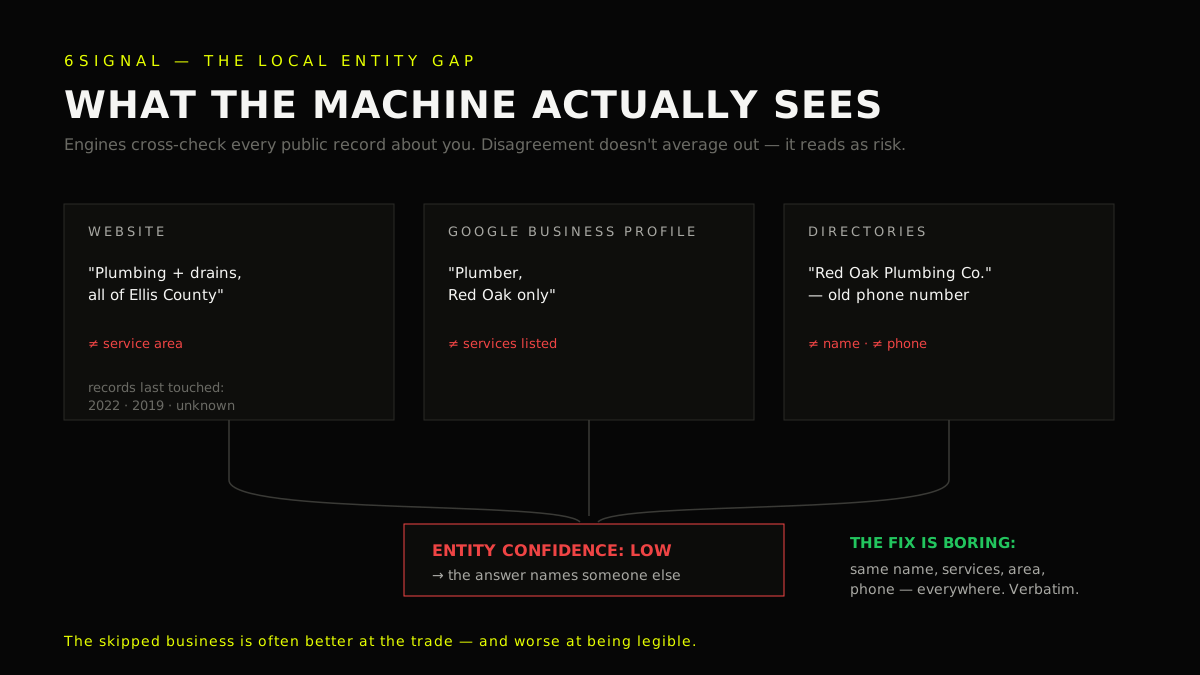
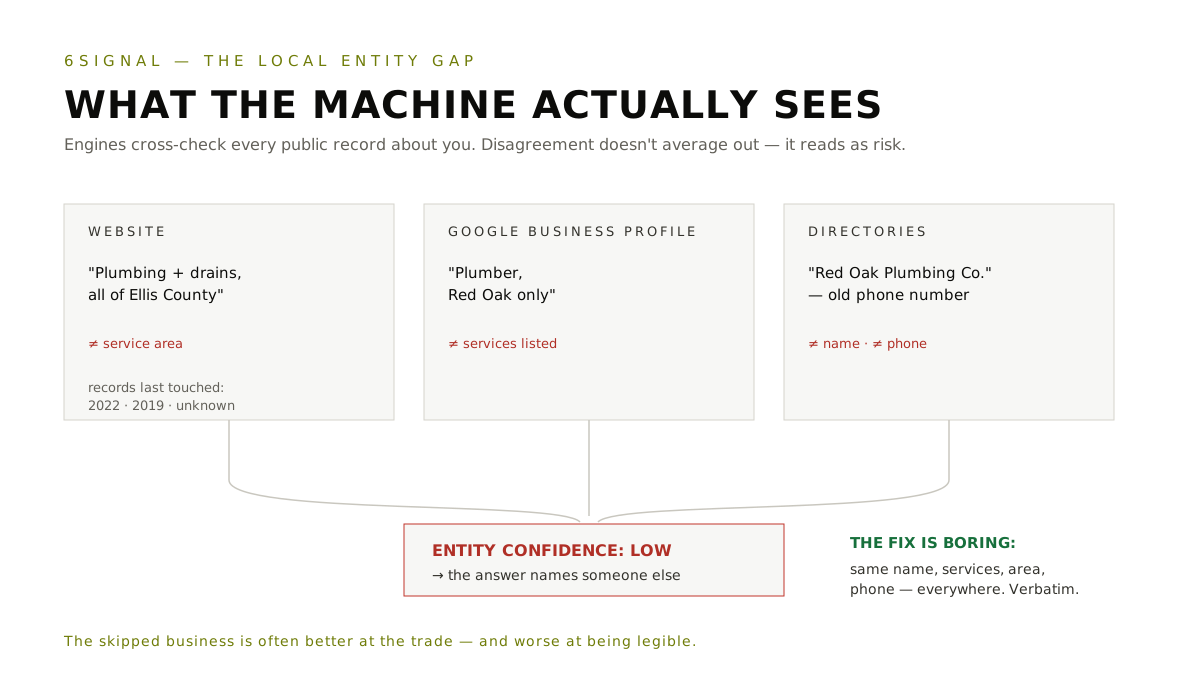
The gap is not about quality. The businesses most damaged by entity gaps are often among the most competent in their market. The gap is about the infrastructure of machine-readable identity. Search engines and AI systems do not infer quality from reputation or read between the lines of a vague services page. They operate on explicit, consistent, multi-source signals—and assign recommendation confidence in proportion to how clearly those signals agree.
A business with a severe Local Entity Gap is not penalized. It is simply invisible to a system that cannot verify it.
The Local Entity Gap is a signal problem, not a quality problem. That distinction matters because it determines what the fix is—and how tractable it is.
Why AI Search Compounds Ambiguity
It is worth being precise about what happens when an ambiguous entity encounters an AI answer engine.
AI search systems—Google AI Overviews, Google AI Mode, Perplexity, ChatGPT, Gemini—do not rank pages. They synthesize responses. The process involves retrieving candidate sources, evaluating their credibility and relevance, checking consistency across sources, and assembling a response the system can deliver with confidence. At every stage, entity clarity is a filtering criterion.
When a user asks Perplexity which plumber to call in their city, the system evaluates each candidate's evidence base. Research into Perplexity's retrieval and citation behavior indicates that pages with schema markup and direct, structured answers to the underlying query intent are significantly more likely to earn citations than comparable pages without that structure. The markup is not a signal of quality—it is a signal of interpretability. Interpretable entities get cited.
Analyses of Google AI Overviews and AI Mode suggest that these systems draw heavily from Google's own data infrastructure—Maps, Business Profiles, the Knowledge Graph—then cross-reference those signals against third-party web content, directories, and review platforms. A business whose GBP is incomplete, whose website contains no structured data, whose citations disagree, and whose reviews are old and generic presents a fragmented picture. The system's confidence threshold is not met. The recommendation goes to an entity that clears it.
One additional pattern worth noting: analyses of Google AI Mode have found that Google-owned properties—Maps, Google.com, YouTube—appear in roughly 17 to 20 percent of all AI citations. This self-referencing tendency reinforces the primacy of GBP completeness. The more thoroughly a business populates its Google-owned properties, the more directly it figures into Google's own AI outputs.
Ambiguity does not trigger a penalty. It triggers a pass.
The Five Entity Gaps
6Signal's diagnostic framework identifies five discrete types of entity gaps. Each maps to a different category of machine-readable signal. Most local businesses with significant AI visibility problems present at least two. Some present all five.
The framework is designed for diagnosis before prescription. Identifying which gaps are present—and their relative severity—determines where to intervene first.
Gap 1: The Identity Gap
The machine cannot confirm who you are.
What it is: The business is represented under inconsistent names, addresses, or phone numbers across platforms. The entity is split, fragmented, or ambiguous at the foundational level.
What it looks like: A roofing company appears as "Smith Roofing" on its website, "Smith Roofing and Construction" on its GBP, and "Smith Roofing LLC" on its BBB listing. The phone number on the site is a call-tracking line that differs from the GBP primary number. The address uses different abbreviations across directories.
Why it matters: NAP consistency—Name, Address, Phone—is the binding mechanism by which Google's Knowledge Graph links disparate mentions to a single real-world entity. When these signals disagree, the Knowledge Graph cannot confidently merge the references. The result is either a fragmented entity with diluted authority across multiple weak records, or a single record with low confidence scores that suppresses local pack visibility and AI citation likelihood.
The fix: Conduct a full citation audit. Standardize on a single business name, address format, and primary phone number. Correct conflicts at the source—do not suppress old listings, update them. This is unglamorous work. It is also the most foundational work in local entity SEO.
Gap 2: The Service Gap
The machine cannot confirm what you do.
What it is: The business's services are described in broad, undifferentiated terms that do not map to the specific queries customers use when they are ready to hire.
What it looks like: A plumbing company's website says "We handle all residential and commercial plumbing needs." There are no individual service pages. The GBP Services section has three entries, none with descriptions. There is no Service schema. A homeowner searching for "trenchless sewer line replacement" or "tankless water heater installation" finds no explicit signal connecting this business to those services.
Why it matters: AI answer engines respond to specific questions. When a user asks which contractor handles a particular service in a particular city, the system looks for explicit service-level signals: dedicated pages, GBP service entries, Service schema, and reviews that name the specific work. Broad descriptions do not map to specific queries. A business that speaks only in generalities is absent from the queries that carry the highest purchase intent.
The fix: Build a dedicated, structured page for each primary service. Populate the GBP Services section with individual entries and descriptions. Implement Service schema on each service page. Prompt satisfied customers to mention the specific service in their reviews. Specificity is the mechanism by which an entity gets matched to a query—not a content strategy preference.
Gap 3: The Location Gap
The machine cannot confirm where you work.
What it is: The business's geographic coverage is undefined, understated, or in conflict across platforms.
What it looks like: A landscaping company serves eight cities across two counties. Its website has one location page—its home city. The GBP service area is unset. LocalBusiness schema specifies only the business address. Searches originating from any community beyond the home city return no confident signal connecting this business to that geography.
Why it matters: Google's local ranking framework treats distance as one of three primary signals—but distance is calculated between the searcher and the geographic signals the business emits. A business that has not defined its service area in GBP, on its website, and in its schema is not visible in the areas it actively serves. For multi-location operations, this compounds: each location requires its own GBP record, its own NAP entry, its own schema, and its own structured content.
The fix: Set the GBP service area explicitly, listing every community served. Build location-specific pages for each primary market. Implement areaServed and geo properties in LocalBusiness schema. Build citations in local directories specific to each service market. Geographic ambiguity is among the most common and most correctable gaps in local entity SEO.
Gap 4: The Proof Gap
The machine cannot confirm you can be trusted.
What it is: The business lacks sufficient, specific, and recent review evidence to support confident AI recommendation.
What it looks like: A remodeling company has 22 Google reviews averaging 4.6 stars, most acquired in 2021–2022. The reviews read: "Great work, would recommend!" No recent review mentions a specific project type, outcome, crew member, or location. The company has not responded to a review in eight months. There are no reviews on Houzz, BBB, or Angi.
Why it matters: Reviews are not social proof appended to a profile. They are evidence. BrightLocal's research places review signals—under Google's "prominence" category—among the most influential factors in local pack rankings. More critically, the content of reviews feeds directly into how AI systems describe and recommend businesses. An AI system asked for the best kitchen remodeler in a given city will surface businesses whose reviews explicitly discuss kitchen projects, project timelines, crew conduct, and outcomes. Generic reviews are not evidence—they are noise. Recency matters as much as volume: analyses of the 2026 local search landscape indicate that recent review activity correlates more strongly with local visibility than historic volume.
The fix: Implement a structured review request process after project completion. Prompt customers to describe what they hired the company for, where the work happened, and what the outcome was. Respond to every review. Expand review presence to platforms where the target audience researches services—Houzz for remodeling, BBB for general contractor trust, Angi for service trades. Review diversity across platforms strengthens the multi-source evidence base AI systems weight most heavily.
Gap 5: The Source Gap
The machine cannot confirm you exist beyond your own properties.
What it is: The business is confirmable only through sources it controls—its own website and its own GBP—with no meaningful third-party corroboration.
What it looks like: An electrical contractor has a functional website and a partially complete GBP. It is not listed on Angi, HomeAdvisor, or Houzz. It has no BBB profile. Its only external mention is a state licensing board directory. There is no local chamber listing, no trade association membership page, no manufacturer authorization record.
Why it matters: Entity confidence in AI systems is a multi-source verification problem. A business confirmable only through its own properties is an entity without corroboration. Analyses of Google AI Overview citation patterns show these systems regularly drawing from third-party review sites, directories, trade association pages, Reddit threads, and niche platforms when compiling local recommendations. Businesses with structured, consistent third-party presence are in the retrieval pool. Businesses absent from it are not.
The specific mechanism by which this plays out: when AI systems cannot find enough independent evidence to surface a specific contractor, they default to surfacing an aggregator—Yelp, Angi, HomeAdvisor—that has stronger entity clarity, deeper review data, and better-structured category pages. This is how qualified contractors lose recommendations to lead-generation intermediaries.
The fix: Build a systematic, prioritized presence on relevant directories. For contractors and home service companies: Yelp, BBB, Angi, HomeAdvisor, and vertical-specific platforms (Houzz for remodeling, Porch and BuildZoom for general trades). Join relevant trade associations—NUCA, PHCC, NECA, ACCA—and ensure memberships are reflected in public listings. Pursue manufacturer dealer or authorization programs where applicable; HVAC brands, roofing manufacturers, and window and door brands all maintain dealer locators that serve as high-authority external entity confirmations. Each credible external mention is a corroboration node in the entity confidence calculation.
Google Business Profile as the Local Entity Hub
Google Business Profile is not simply a citation or a directory listing. For mobile and Maps-initiated local searches—a substantial and growing share of local service discovery—GBP is the primary interface through which potential customers encounter the business. It is also the primary data source from which Google's AI systems pull local business information when constructing AI Overviews and AI Mode responses.
Google's official documentation frames local ranking around three factors: relevance (how well the profile matches the search), distance (proximity to the searcher), and prominence (the business's broader reputation and authority). GBP data directly influences all three.
Name and category function as the entity's primary classification signal. The name must match exactly what appears on every other platform. Primary category selection is among the strongest relevance signals in local search—it determines which queries the entity is considered eligible for.
Services and attributes extend the entity's specificity beyond the category. The GBP Services section accepts individual service entries with descriptions and pricing. Attributes—"licensed," "veteran-owned," "emergency service available"—add specificity that a generic website cannot provide and that AI systems can reference when answering particular queries.
Service area is one of the most commonly overlooked fields and one of the most consequential. An unset service area tells Google nothing about where the business actually works.
Hours and contact information establish a consistency check between the GBP and the website. Discrepancies create Knowledge Graph conflicts that reduce entity confidence.
Photos and posts communicate recency. An active GBP—updated photos, current posts, owner responses—signals an operating business. Dormant profiles correlate with depressed local pack performance.
Q&A provides a structured opportunity to pre-answer the questions customers ask before hiring. These answers are indexed and, in some cases, surfaced directly by AI systems.
GBP is not set-and-forget infrastructure. Post-March 2026 analyses suggest that GBP completeness, review recency, and owner response rate are increasingly correlated with local pack performance—not as a onetime achievement, but as an ongoing operational baseline.
Reviews as Entity Data
Reviews are commonly positioned as conversion assets—social proof that converts browsers into callers. That framing is too narrow for the AI search context.
Reviews are evidence. They are third-party, natural-language testimony about a business's services, geographic coverage, quality of execution, and reliability. They are among the most credible signals available to AI systems precisely because they are generated by external parties in unstructured language—which makes them difficult to fabricate at scale and more likely to reflect operational reality.
BrightLocal's consumer research establishes that named, detailed reviews—written by real, identifiable people describing specific experiences—carry substantially more trust weight than anonymous or generic reviews. The same asymmetry applies to machine readers. A review that says "Marco replaced our water heater on a Saturday afternoon, had the new unit installed in three hours, and cleaned up completely before leaving" provides specific service, location context, urgency signal, and outcome data. An AI system asked about same-day water heater replacement will find that review meaningfully more informative than "very professional, highly recommend."
The entity clarity implications of review content map directly to the Five Entity Gaps:
- Reviews that name specific services reinforce the Service signal.
- Reviews that mention city, neighborhood, or zip code reinforce the Location signal.
- Reviews that describe project outcomes and crew conduct reinforce the Proof signal.
- Reviews distributed across Google, Yelp, BBB, Houzz, and Angi reinforce the Source signal.
Owner responses matter independently. Responding to every review—positive and negative—demonstrates active management. This correlates with GBP prominence signals and communicates to AI systems that the business is current and engaged.
The practical implication for review strategy: acquisition should include customer guidance on specificity. Not scripted language—genuine descriptions of real work. The goal is to move from "five stars, great company" to "Mike's crew replaced our entire HVAC system in one day, in McKinney, in August. No complaints."
Citations and Directories as AI Source Infrastructure
Raw citation volume lost its primacy as a local ranking lever in the early 2020s. Many local businesses interpreted this as permission to ignore citations entirely. That was the wrong conclusion.
Citations serve two distinct and current functions in the local entity clarity framework.
NAP consistency. Every citation containing the business's name, address, and phone number is a data point in the Knowledge Graph's entity record. When all citations agree, the entity is coherent. When they conflict—legacy addresses, name variations, disconnected tracking numbers—the entity is fragmented. Fragmented entities carry lower confidence scores, which suppresses local pack visibility and reduces the likelihood of AI citation.
Source diversification. AI Overview citation analyses consistently show these systems drawing from Yelp, TripAdvisor, Angi, HomeAdvisor, Houzz, BBB, Reddit threads, niche review platforms, and local directories when compiling recommendations for local queries. A business with substantive listings on these platforms is in the retrieval pool. A business absent from them is not competing for those citations regardless of the quality of its own site.
For contractors and home service companies, directory prioritization should follow the actual research behavior of the target audience and the observed citation behavior of the relevant AI systems:
| Platform type | Examples |
|---|---|
| General consumer review | Yelp, BBB, Angi, HomeAdvisor, Thumbtack, Nextdoor |
| Trade-specific | Houzz, Porch, BuildZoom |
| Trade associations | NUCA, PHCC, NECA, ACCA, state-level equivalents |
| Manufacturer programs | HVAC dealer locators, roofing certified contractor programs |
| Local institutional | Chamber of commerce, city business directories |
The strategic goal is not directory volume. It is corroboration density—the number of credible, consistent, independent sources that confirm the entity is real, current, and operating in the claimed geography.
Schema and Structured Data
Schema markup—implemented in JSON-LD format, which Google explicitly recommends—is the mechanism by which a business communicates its identity to search engines and AI systems in a language those systems read natively.
For local service businesses, five schema types carry the most weight:
LocalBusiness schema is the entity's machine-readable identity record. It communicates name, address, phone, website URL, geographic coordinates, business hours, and service area. The sameAs property links the entity record to verified external profiles—GBP, Yelp, BBB, trade association pages—explicitly establishing corroboration. The areaServed property defines geographic coverage in structured terms. These are the properties that enable entity disambiguation: they tell systems not just who the business is, but where it operates and where else it can be confirmed.
Service schema extends the entity definition to specific offerings. It is the machine-readable equivalent of a service page—the mechanism by which an AI system matches the entity to a specific query type rather than a general category.
FAQPage schema structures question-and-answer content for direct extraction. AI systems asked "how much does water heater replacement cost in [city]" or "does [company] offer emergency service" can surface FAQPage-annotated content directly in responses. This is one of the most tractable content-level opportunities in AEO and GEO for local businesses.
Review schema surfaces aggregated review data in rich result formats, making star ratings and review volume visible before the click.
BreadcrumbList schema clarifies site hierarchy, helping AI systems understand the relationship between service pages, location pages, and the homepage—which improves the accuracy with which the entity's content is interpreted.
One constraint that must be stated plainly: schema markup clarifies real information. It does not manufacture authority. Implementing LocalBusiness schema on a page with an inconsistent address, a vague services description, and no reviews does not close the entity gap—it annotates the gap in structured language. Schema is the translator. The substance being translated must be accurate and complete before the translation has value.
Why Aggregators Win When Local Companies Are Unclear
One of the most consequential patterns in local AI search is the frequency with which aggregators outperform the individual businesses they aggregate.
Consider the query: "Who are the best plumbers near me?" An AI system retrieves candidates. Yelp's local plumber page has structured category data, hundreds of reviewed businesses, location signals, star ratings, price ranges, and dense crawlable review content—all clearly marked up and internally consistent. Angi's equivalent page has comparable structure. A specific local plumbing company's site has a homepage, a generic services page, eight Google reviews from 2022, and no schema.
The aggregator gets cited. Not because the aggregator's plumbers are better—Yelp does not do plumbing. Because Yelp's entity signal for the category is stronger, more structured, and more verifiable than the actual business's entity signal for itself.
Analyses of Google AI Overviews confirm the pattern: Yelp, TripAdvisor, Reddit, and vertical directories appear regularly in AI-generated local recommendations. Studies of AI Mode suggest a substantial share of citations come from outside the top traditional organic rankings—often from structured sources with strong entity clarity. Directories qualify. Local contractors, absent deliberate entity work, generally do not.
This is the aggregator advantage: not better service, but better infrastructure. The mechanism is correctable. A contractor who builds entity clarity—complete GBP, consistent NAP, specific reviews, structured service pages, schema markup, and directory presence—competes directly with aggregators for AI citation. The gap closes through the same work that should have been done years ago.
Local Entity Gap Examples by Trade
The Five Entity Gaps manifest with different signatures across contractor and home service categories.
Roofers: Location and Source gaps dominate. Service areas extend well beyond the home city but are rarely defined. Reliance on HomeAdvisor and a single GBP listing leaves the entity without independent corroboration. Reviews mention storms and speed but rarely roofing system types, manufacturer warranties, or specific materials—missing the Service signal that differentiates premium work from commodity repair.
Plumbers: Service gaps are the endemic problem. Emergency plumbing, sewer line work, water heater replacement, and fixture installation are distinct service signals with distinct query sets—but most plumbing websites treat them as a single undifferentiated offering. Proof gaps compound: reviews exist but contain no specifics about the work performed.
HVAC: Manufacturer authorization programs—Carrier, Trane, Lennox, Mitsubishi, Daikin—produce high-authority external entity confirmations through brand dealer locators. Most HVAC companies are enrolled in these programs and have not ensured their dealer page is accurate, current, or linked in their schema. Service gaps around system types (mini-splits, geothermal, commercial equipment) are equally common.
Electricians: Identity gaps from naming inconsistency are particularly damaging because state licensing board directories—an authoritative external source—often contain a legal entity name that conflicts with the trade name used in GBP and directories. This creates a Knowledge Graph conflict at the most authoritative corroboration source available.
Remodelers: Proof gaps dominate. Kitchen and bathroom remodelers attract high-consideration, research-intensive queries. Review specificity correlates strongly with AI citation eligibility for this category. A remodeler with 40 generic reviews is effectively invisible to the AI systems a homeowner uses to build a shortlist.
Garage door companies: One of the most heavily aggregated home service categories. Yelp and Angi dominate AI citations across most markets. Companies that build manufacturer authorization presence—LiftMaster, Clopay, Amarr dealer pages—and invest in vertical directory listings establish AI citation eligibility that most competitors in the category have not pursued.
Landscaping and tree service: Location gaps are the defining problem. These businesses serve large geographic areas while defining their entity around a single origin address. Dozens of communities they actively serve have no entity signal connecting them to this business.
Pest control: Service specificity matters more than in almost any other trade. General pest control, termite treatment, bed bug remediation, rodent exclusion, and wildlife control are not variants of one service—they are different services with different query sets. Most pest control websites present them as a single offering.
Foundation and concrete: Among the thinnest digital presences of any trade category. Entity gaps across all five dimensions are common. The competitive entity baseline is low. The opportunity is proportionally large.
Commercial contractors: Source gaps are the primary challenge. Project references, subcontractor qualification lists, bonding documentation, and trade association memberships are the corroboration sources that carry weight in a market where vendor evaluation often begins with AI-assisted research before a single phone call is made.
The Local Entity Audit
This is a working diagnostic, not a marketing document. Use it before any entity work begins. The output determines the sequence of every subsequent action.
Identity
- Is the business name character-for-character identical across the website, GBP, Yelp, BBB, Angi, and all active directories?
- Is the address formatted identically across all platforms—same abbreviations, suite number treatment, zip code?
- Is the primary phone number identical everywhere, with no active tracking lines appearing in public-facing citations?
- Does the canonical website URL match the GBP and all directory listings exactly (including www vs. non-www, http vs. https)?
Categories and Services
- Is the GBP primary category the most specific available option that accurately describes the business?
- Is the GBP Services section populated with individual service entries, each with a description?
- Does the website have a dedicated page for each primary service—not a consolidated services page listing everything?
- Are service names consistent between the website, GBP, and schema markup?
Location
- Is the GBP service area explicitly set, listing every community the business actively serves?
- Does the website include location-specific pages or content for each primary market beyond the home city?
- Does the LocalBusiness schema include both
areaServedandgeoproperties with accurate values? - Are there city-specific citations in local directories for each service market, not just the home city?
Reviews
- What is the review count, average rating, and recency distribution on Google? What percentage were posted in the last 90 days?
- Are reviews present on at least two secondary platforms relevant to the trade (Yelp, BBB, Houzz, Angi)?
- Do the ten most recent reviews mention specific services, geographic locations, or project outcomes—or are they generic?
- Has the business responded to every review posted in the last six months?
Schema and Structured Data
- Is LocalBusiness schema implemented in JSON-LD on the homepage, with name, address, phone, URL, coordinates, hours, service area, and
sameAslinks? - Is Service schema present on each individual service page?
- Is FAQPage schema implemented on any FAQ-formatted content?
- Has all schema been validated through Google's Rich Results Test with zero errors?
Citations and Directories
- Is the business listed on Yelp, BBB, Angi, HomeAdvisor, and Thumbtack?
- Are all active trade association memberships reflected in public-facing directory listings?
- Are manufacturer or brand authorization pages current, accurate, and linked in schema?
- Is the business listed in the local chamber of commerce directory?
Content
- Does the website answer the specific questions customers ask before hiring—cost, timeline, licensing, process?
- Is there location-specific content that names the communities served and describes work done there?
- Is FAQ content structured in question-and-answer format that FAQPage schema can annotate?
Third-Party Proof
- Are there web mentions of the business beyond directories—local news, trade publications, community sites, partner pages?
- Is the business referenced by name on any supplier, manufacturer, or association website?
AI Visibility Testing
- When prompted with "[service] in [city]" queries in Google AI Mode, Perplexity, and ChatGPT, does this business appear?
- When prompted directly with the business name, do AI systems describe it accurately and completely?
- Which competitors appear in AI-generated local recommendations for the business's primary queries?
- Which sources—directories, platforms, competitor sites—does the AI cite when recommending alternatives?
The 90-Day Local Entity Cleanup Roadmap
Entity clarity is infrastructure, not a campaign. It does not produce overnight results. It produces compounding returns. The following roadmap is sequenced by dependency: each phase makes the next phase more effective.
Phase 1 — Entity Baseline (Days 1–7)
Complete the full local entity audit above. Document every inconsistency, every missing element, every gap across the five dimensions. Run AI prompt tests across Google AI Mode, Perplexity, and ChatGPT for the five to ten queries that matter most to the business. Record exactly what each AI says, what it cites, and whether this business appears. This baseline is the measurement point against which all subsequent work is evaluated.
Deliverable: A ranked gap inventory with severity ratings across all five entity gap types.
Phase 2 — GBP Cleanup (Days 7–21)
Correct the GBP business name to match the exact, standardized trade name used everywhere else. Verify the primary category—this decision determines query eligibility and warrants genuine research. Add all applicable secondary categories. Populate the Services section completely with individual entries and descriptions. Set the service area to include every community served. Update hours, attributes, and business description. Replace placeholder or stock photos with current images of the actual crew, vehicles, work sites, and completed projects.
Deliverable: A fully completed GBP with no empty fields, verified against Google's completeness indicators.
Phase 3 — Citation Cleanup (Days 14–30)
Run a citation audit through Moz Local, BrightLocal, or a manual search of the top 50 directories. Identify every listing with a name variation, address discrepancy, or phone number conflict. Correct each at the source—do not delete listings, update them. Add the business to any major directory where it does not currently appear. Document every correction made and the date it was made. This phase overlaps with Phase 2 deliberately: GBP corrections should be mirrored immediately in the citation cleanup pass.
Deliverable: A citation inventory with conflict resolution log.
Phase 4 — Service-Page Refinement (Days 21–45)
Audit the website's service architecture. Every primary service requires its own page. Each page should name the service specifically, describe the process, name the communities where the service is performed, answer the two or three questions customers ask before hiring, and include a relevant review or testimonial where available. Internal linking should connect every service page to related services and relevant location content. The goal is a site structure that mirrors the specificity of the queries it needs to match.
Deliverable: Individual service pages for each primary offering, with internal linking completed.
Phase 5 — Review Specificity Campaign (Days 30–60)
Implement a post-completion review request process. The ask should be immediate—within 24 to 48 hours of project completion. Prompt customers to describe what they hired the company for, what city or neighborhood the work was in, and what the outcome was. Set up a response process: every incoming review gets a response within 24 hours. Begin building review presence on the secondary platforms most relevant to the trade. If reviews on Houzz, BBB, or Angi are absent, create a prioritized outreach plan to existing customers.
Deliverable: A review request workflow, a response protocol, and a 90-day review velocity target.
Phase 6 — Schema Implementation (Days 45–60)
Implement or audit LocalBusiness schema on the homepage in JSON-LD format. Required properties: name, address, telephone, url, geo, openingHours, areaServed, sameAs. The sameAs array should link to every verified external profile—GBP, Yelp, BBB, Angi, trade association pages. Add Service schema to each individual service page. Add FAQPage schema to any FAQ-formatted content. Validate everything through Google's Rich Results Test. Correct all errors before considering this phase complete.
Deliverable: Validated schema across homepage and all service pages, with zero Rich Results Test errors.
Phase 7 — Third-Party Proof Building (Days 60–75)
Apply to relevant trade associations where the business is not yet a member, and ensure all existing memberships produce a public-facing directory listing with current information. Apply to manufacturer dealer or authorization programs where applicable—these produce high-authority external entity confirmations that most competitors have not pursued. Confirm the chamber of commerce listing is current. Identify any local press, project portfolio, or community content opportunity that would place the business's name on a credible external site with a geographic and service reference.
Deliverable: A third-party presence expansion log with status tracking per platform.
Phase 8 — AI Prompt Monitoring (Days 75–90, then monthly)
Return to the baseline AI prompt tests from Phase 1. Run the same queries across Google AI Mode, Perplexity, ChatGPT, and Gemini. Document what has changed: does the business appear where it did not before? Is it described more accurately? Which citations does the AI use? What gaps remain visible in the AI's picture of the entity? Use these findings to prioritize the next round of content, citation, and review work. AI prompt monitoring is not a onetime exercise—it is the feedback loop that makes entity work accountable.
Deliverable: A comparative AI visibility report against the Phase 1 baseline.
Common Mistakes
These patterns appear in the overwhelming majority of local service businesses presenting with entity gaps.
Treating the website as the complete visibility solution. A website is one node in a multi-source entity system. An excellent website on a fragmented entity foundation consistently underperforms a mediocre website on a coherent one.
Inconsistent business names. Every name variation—abbreviation, punctuation, DBA versus trade name—creates a potential split in the Knowledge Graph entity record. There is no minor variation.
Active tracking numbers in public citations. Call-tracking lines have legitimate internal uses. When they appear as the primary phone number in public directories, they create NAP conflicts that undermine entity coherence across every platform that cached the number.
Undifferentiated service descriptions. "We handle all your plumbing needs" tells a machine nothing. AI systems match queries to entities based on specific service signals. Vague descriptions produce no match for specific queries.
Generic reviews. "Great service, five stars" contributes almost nothing to entity clarity for AI systems. A review describing a specific service, in a specific location, with a specific outcome is evidence. Volume of generic reviews does not substitute for specificity of useful ones.
Ignoring secondary directories. The directories that matter most for AI citation are often not the ones businesses feel obligated to appear on. Yelp, Houzz, BBB, and Angi are frequently cited by AI systems for local queries. Absence from these platforms removes the business from a retrieval pool it could legitimately occupy.
Implementing schema on thin or inaccurate content. Schema that annotates a vague services page with incorrect hours and an old address does not help. It formalizes the problem in machine-readable language.
Location pages that exist but do not function. A page titled "Plumber in Dallas" with one paragraph and no local specifics is a placeholder, not a location signal.
Treating citation maintenance as completed work. Businesses move. Phone numbers change. Brands evolve. Every operational change requires a citation update sweep. Citations accurate two years ago may be creating conflicts today.
Not testing what AI systems actually say. Most local businesses have never prompted an AI assistant to recommend a service provider in their market. This is the most direct diagnostic available. The test takes five minutes. The result is specific and actionable.
What Winning Looks Like
A local entity with full clarity has observable, replicable characteristics. The work required to reach this state is not exotic—it is thorough.
The business name is identical everywhere. One name. One address format. One primary phone number. No legacy variations in active directories, no tracking lines in public citations, no conflict between what the GBP says and what the website says.
The GBP has no empty fields. Categories are precise. Services are enumerated individually with descriptions. Service area covers every community served. Hours are current. Photos document real work and real people. Reviews are recent, specific, and responded to consistently.
The website is organized around services and geography. Each primary service has its own page. Each primary market has its own content. FAQs answer the questions customers actually ask before hiring.
Schema is implemented, validated, and internally consistent with every other entity signal. LocalBusiness, Service, FAQPage, and BreadcrumbList schemas are present, error-free, and linked to verified external profiles through sameAs.
Reviews exist on multiple platforms. They are recent. They describe specific work in specific places with specific outcomes. The owner responds.
Directory presence is systematic. The business appears on every platform relevant to its trade and geography. NAP is consistent across all listings. Trade associations, manufacturer programs, and local institutions independently confirm the entity.
When an AI system is asked about contractors in this business's market, this business clears the confidence threshold—because every source the system checks tells the same story, specifically and without conflict.
Closing the gap starts at the entity hub — Google Business Profile as local AI infrastructure — and extends through the full stack in the Local AI Infrastructure Blueprint.
The 6Signal Point of View
The structural shift from keyword rankings to entity-based AI recommendations will not reverse. AI systems will become more authoritative in local discovery, not less. The businesses that build clear, consistent, multi-source entity signals now are building a compounding position. The businesses that defer—treating citation maintenance as historical, schema as a developer problem, and reviews as self-managing—will find the gap widening with each AI product cycle.
What must be said plainly: entity clarity does not guarantee AI citation. Google's selection models are not publicly documented. Inclusion in AI Overviews, AI Mode, or Perplexity responses depends on query-level relevance, local competition, and factors practitioners infer from external research rather than confirmed specifications. No schema implementation, directory strategy, or review count guarantees a specific placement.
What entity clarity does guarantee is this: it removes the avoidable reasons an AI system would pass on a business. It closes the gaps that are within a business's control to close. The rest is competition.
The clearest company has the highest probability of recommendation. Not always the biggest. Not always the oldest. The clearest.
6Signal works with businesses that are already good at what they do and deserve to be found for it. The work is precise, unglamorous, and consequential.
Visibility Audit: Start with Clarity on Where You Stand
Most businesses that would benefit from entity work do not know their current entity state. They have never run the AI prompt tests. They have not audited their citations. They do not know which queries they appear in and which they are absent from.
A 6Signal Visibility Audit maps exactly that.
We identify where the business appears across AI search, local packs, Maps, and major directories. We document where it is skipped, which signals are missing or conflicting, and what the highest-leverage corrections are—in priority order, not as a comprehensive list of everything.
The output is a ranked action list tied to the specific gaps found. Not a report for the shelf.
Start at 6signal.co/audit.
Sources and Further Reading
Google Official Documentation
- Google: Local Ranking Factors (Relevance, Distance, Prominence) — https://support.google.com/business/answer/7091
- Google: LocalBusiness Structured Data — https://developers.google.com/search/docs/appearance/structured-data/local-business
- Google: Structured Data Overview and Rich Results Testing — https://developers.google.com/search/docs/appearance/structured-data
Local SEO and Structured Data
- Search Engine Journal — Local SEO Schema: A Complete Guide — https://www.searchenginejournal.com/how-to-use-schema-for-local-seo-a-complete-guide/294973/
- BrightLocal — Google's Local Algorithm and Local Ranking Factors — https://www.brightlocal.com/learn/google-local-algorithm-and-ranking-factors/
- BrightLocal — Local Consumer Review Survey 2024 — https://www.brightlocal.com/research/local-consumer-review-survey-2024/
- Search Engine Land — 5-Step Google Business Profile Audit — https://searchengineland.com/google-business-profile-audit-local-rankings-472990
- MapRanks — How Google Business Profile Rankings Impact Local SEO in 2026 — https://www.mapranks.com/2026/01/12/how-google-business-profile-rankings-impact-local-seo-in-2026/
- Rio SEO — 2025 Top Local Search Trends — https://www.rioseo.com/blog/2025-top-local-search-trends/
AI Search, Answer Engines, and Local Visibility
- Search Engine Journal — How To Build Local Pages That Win In AI-Powered Search — https://www.searchenginejournal.com/how-to-build-local-pages-that-win-in-ai-powered-search/574668/
- Entrepreneur — The New Rules of Local Visibility in an AI-Driven Search World — https://www.entrepreneur.com/starting-a-business/the-new-rules-of-local-visibility-in-an-ai-driven-search/502914
- Local Falcon — Where Do Google AI Overviews Get Information for Local Businesses — https://www.localfalcon.com/blog/where-do-google-ai-overviews-get-information-from-for-local-businesses
- LocalIQ — How AI Overviews Impact Local Businesses — https://localiq.com/blog/ai-overviews/
- Search Engine Land — Google's AI Mode Is Citing Google More Than Any Other Site — https://searchengineland.com/google-ai-mode-citing-google-more-study-471042
- AlmCorp — Google AI Mode Cites Itself in 17% of All Answers — https://almcorp.com/blog/google-ai-mode-cites-itself-organic-links-seo-2026/
- WPRiders — Schema Markup: 8 Tactics to Boost AI Citations — https://wpriders.com/schema-markup-for-ai-search-types-that-get-you-cited/
- Opace — Structured Data and Schema for SEO: AI Search, GEO and AEO — https://opace.agency/blog/structured-data-schema-for-seo/
- ZipTie — How Perplexity AI Answers Work: Retrieval, Ranking, and Citation — https://ziptie.dev/blog/how-perplexity-ai-answers-work/
- ZipTie — Google AI Overviews Source Selection — https://ziptie.dev/blog/google-ai-overviews-source-selection/
- Unosearch — How Does Perplexity AI Choose Citations in 2026 — https://unosearch.io/blogs/how-does-perplexity-ai-choose-citations-2/
Schema Reference
- Schema.org — LocalBusiness — https://schema.org/LocalBusiness
© 2026 6Signal. Research-backed visibility for local service businesses. This white paper may be cited with attribution.